
Key takeaways
- 503A and 503B are sections of a federal law, not quality grades. They describe two different jobs, with two different regulators.
- A 503A pharmacy compounds for one named patient against a prescription, and answers to your state board of pharmacy.
- A 503B outsourcing facility registers with the FDA, is inspected by the FDA, follows cGMP, and can make batches without a prescription.
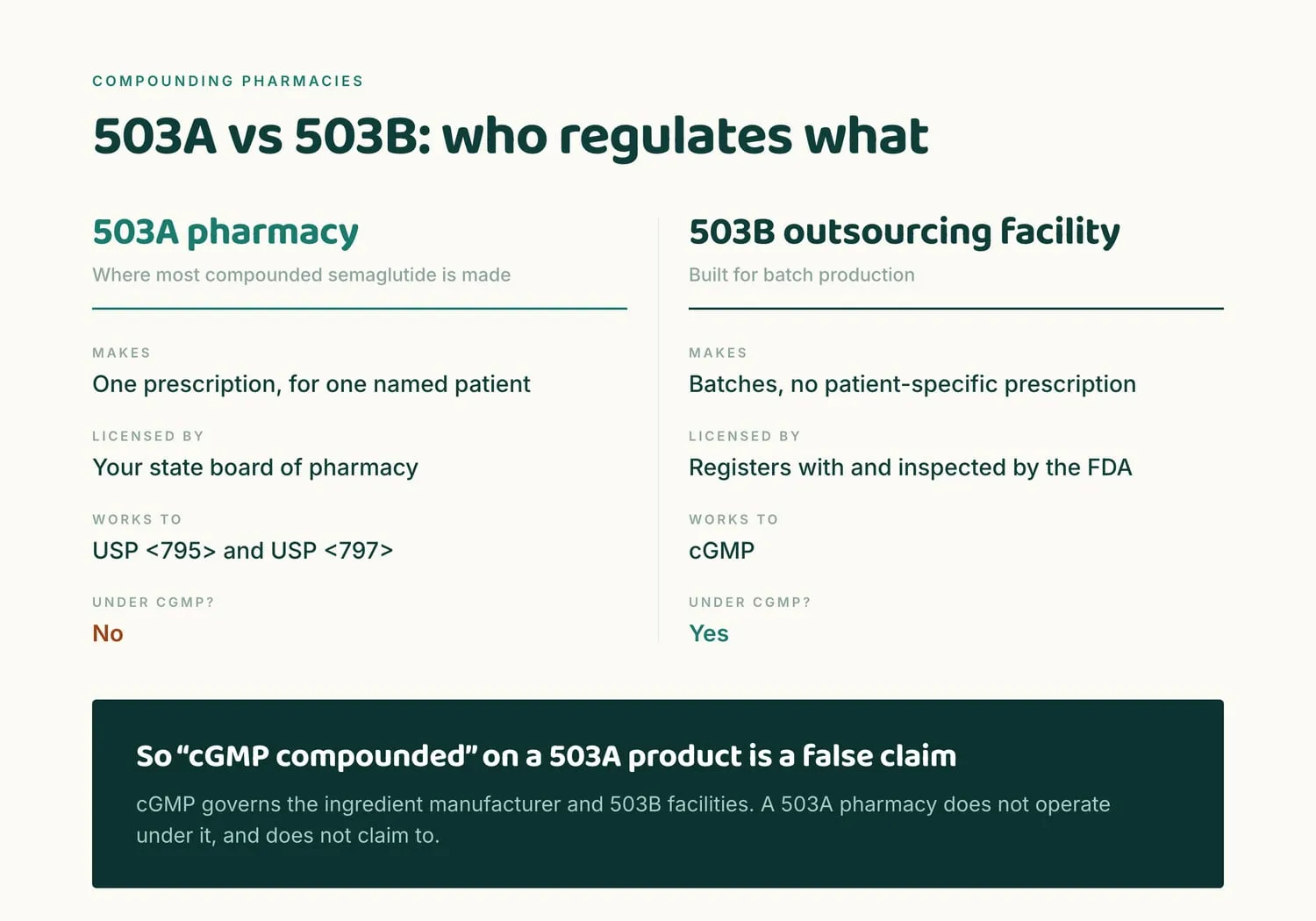
- cGMP applies to 503B, not 503A. So “cGMP compounded” on a patient-specific prescription is a claim the pharmacy cannot support.
- Neither is better. Ask which one made your medication, then check it. The FDA publishes the full list of registered outsourcing facilities.
If you have ordered a compounded medication online, someone has probably told you their pharmacy is “503A” or “503B” as though that settled something. It doesn’t, on its own. Both numbers are just references to sections of a federal law, and knowing which one applies tells you who inspects the place, what rules it works under, and what claims it is allowed to make about itself.
That last part is where it gets useful. Once you know the difference, you can spot a company describing its product in a way its own pharmacy could not support. That happens more than it should.
What the numbers actually mean
503A and 503B are sections of the Federal Food, Drug, and Cosmetic Act. The Drug Quality and Security Act created section 503B after a 2012 meningitis outbreak, which investigators traced to contaminated injections from a compounding pharmacy in Massachusetts. That outbreak is the reason the second category exists at all.
Neither number is a rating. A pharmacy does not graduate from 503A to 503B, and a 503B facility is not a “better version” of a 503A one. They do different jobs, and a compounder elects which set of rules to operate under.
One consequence surprises people: the FDA has stated that once a facility registers as an outsourcing facility, its compounded drugs are regulated under 503B and cannot claim the 503A exemptions, even if it happens to be filling a patient-specific prescription. You pick a lane.
What a 503A pharmacy is
A 503A pharmacy compounds a medication for one identified patient, against a prescription written by a licensed provider for that person.
Its license and its inspections come from a state board of pharmacy, not the FDA. For sterile preparations, which includes anything injectable, it works to United States Pharmacopeia standards, principally USP chapter 795 for non-sterile preparations and USP chapter 797 for sterile ones. Those chapters govern how a pharmacy makes a preparation, the environment it works in, what it tests, how long the preparation keeps, and what it must document.
Compounded drugs from a 503A pharmacy are not FDA-approved, and the FDA does not review them for safety, effectiveness or quality before they reach a patient. That is not a loophole. It is the design of the category, and the agency says so plainly.
Most compounded semaglutide and most compounded peptides dispensed by American telehealth services come from 503A pharmacies.
What a 503B outsourcing facility is
A 503B outsourcing facility is a different animal, and the differences are structural rather than cosmetic.
It registers directly with the FDA. The FDA then inspects it on a risk-based schedule. Such a facility must comply with current Good Manufacturing Practice, the same broad framework that governs commercial drug manufacturing, and it owes the agency two further duties: reporting adverse events, and telling the FDA what products it compounds.
In exchange, it can compound in batches without a prescription for a named patient, and sell those batches to hospitals and clinics for use in the office. Its products are exempt from FDA approval and from the requirement to carry adequate directions for use, but, in the FDA’s own framing, not from cGMP.
The practical upshot: a 503B validates its processes and tests its batches because the law requires it, and a federal agency inspects the place and says so publicly when it finds problems.
The differences that actually affect you
| 503A pharmacy | 503B outsourcing facility | |
|---|---|---|
| Regulated by | State board of pharmacy | FDA (registered, inspected on a risk-based schedule) |
| Needs your prescription first | Yes, made for one named patient | No, made in batches |
| Quality standard | USP <795> and <797> | cGMP |
| Typically supplies | Individual patients | Hospitals, clinics, provider offices |
| Can call itself “FDA-registered” | No | Yes |
Most comparisons of these two speak to pharmacy owners and prescribers. Here is the version that matters if you are the person injecting the medication.
Who inspects it. A 503A answers to your state board of pharmacy. A 503B answers to the FDA. Both are real oversight, but they are different bodies with different powers, and you look them up in different places.
Whether a prescription had to exist first. A 503A pharmacy compounds because a licensed provider wrote a prescription for you specifically. A 503B facility can produce a batch before anyone has a prescription at all.
How long it keeps. Products from a 503B generally carry longer beyond-use dates, because the stability work behind them is more extensive. A 503A pharmacy usually compounds closer to the moment you need it, and dates the preparation more conservatively.
What testing is mandatory. This is the point most often reported unfairly, usually by companies with a stake in the answer. Under cGMP a 503B has to validate its processes and test batches. A 503A is not under cGMP, so it has no cGMP batch-testing obligation. That is not the same thing as “untested.” A 503A still works under USP 795 and 797, which impose their own requirements around sterility, environmental monitoring and beyond-use dating, and many 503A pharmacies send finished product to independent labs voluntarily.
The honest summary: federal law compels rigorous testing at a 503B. At a 503A, USP standards require some testing, and anything beyond that reflects a choice the pharmacy makes. Which is exactly why asking a 503A what it tests, and who does the testing, is a fair and revealing question.
So which is better, 503A or 503B?
Neither, and any company answering that question confidently is usually selling whichever one it happens to use.
The categories exist for different jobs. If a medication has to be made for you specifically, at a dose or in a form that no manufacturer offers, that is 503A work by definition. A 503B cannot personalize a batch it made last month for nobody in particular. If a hospital needs a thousand identical syringes ready for use in a clinic, that is 503B work, and a 503A pharmacy is not permitted to supply it.
The real question is not which section your pharmacy falls under. It is whether the pharmacy is licensed, in good standing, and willing to tell you what it does. A well-run 503A under active state board oversight is a serious pharmaceutical operation. A registered 503B that has been inspected and found wanting is not automatically safer because of its number.
What should worry you is a seller in neither category: no state license, no FDA registration, and no interest in discussing either.
The claim to watch for
cGMP gets thrown around in compounding marketing more than any other term, so it is worth being exact about where it applies.
The manufacturer of the active pharmaceutical ingredient operates under cGMP. A 503B outsourcing facility operates under cGMP for its compounding. A 503A pharmacy does not. It works under state licensure and USP standards.
So when a telehealth company tells you its patient-specific compounded prescription was “made under cGMP,” one of two things is true. Either the product came from a registered 503B outsourcing facility, which is checkable in about a minute, or the claim is not accurate. There is no third option where a 503A pharmacy is quietly cGMP-compliant.
This is worth knowing because it is one of the few claims in this industry you can test yourself without any expertise. Ask which pharmacy made it, ask whether that pharmacy is a registered outsourcing facility, and then go and look.
How to find out which one made your medication
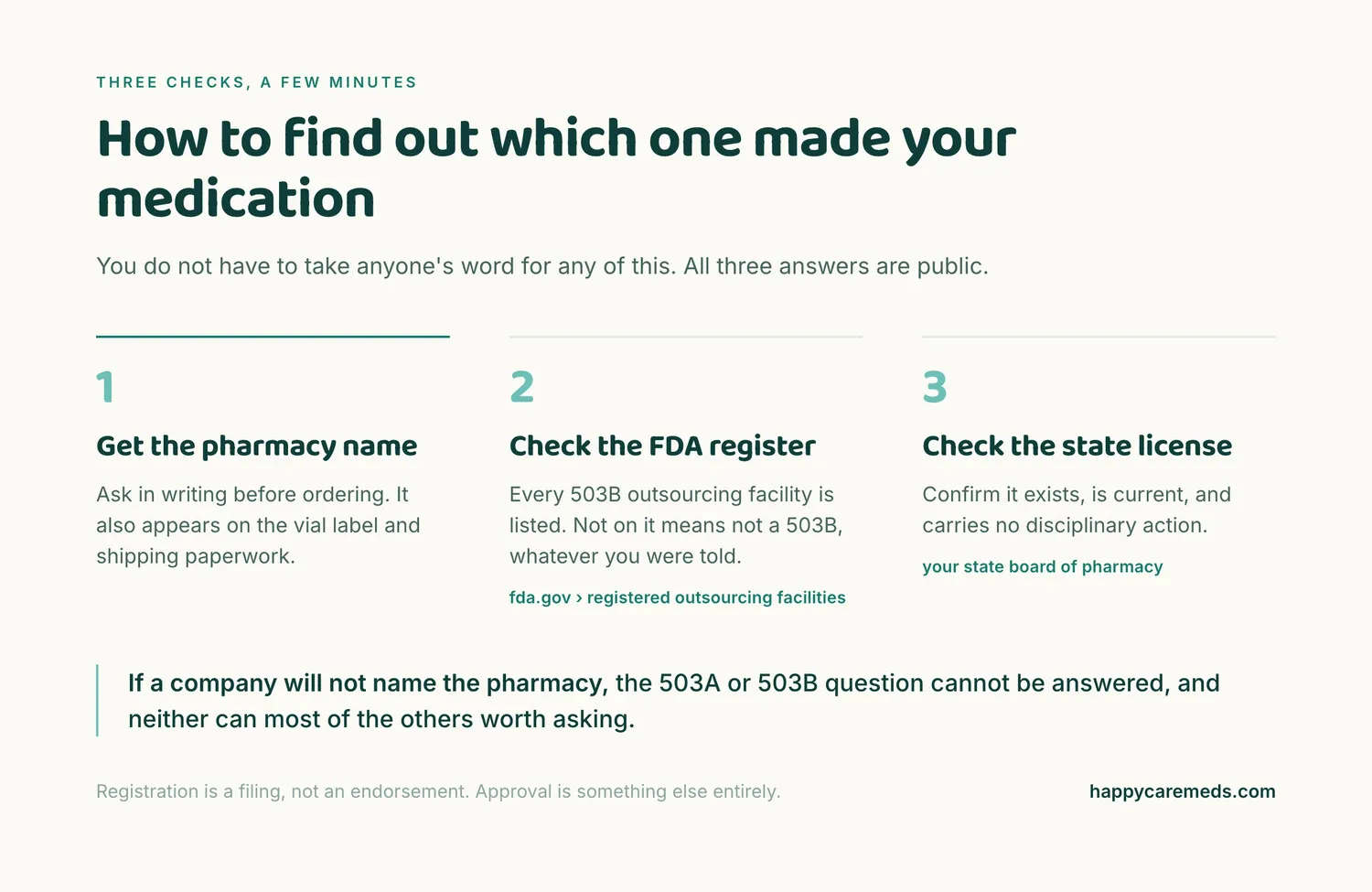
Three steps, and none of them require taking anyone’s word for it.
1. Get the pharmacy’s name. Ask the company in writing before you order. After it arrives, the compounding pharmacy is normally identified on the vial label and on the shipping paperwork.
2. Check the FDA’s outsourcing facility list. The FDA publishes a register of every 503B outsourcing facility. If the pharmacy is on it, it is a 503B. If it is not, it is not one, whatever anybody has told you.
3. Check the state board of pharmacy. Every state publishes a license lookup. Search “[your state] board of pharmacy license verification,” or use the Alliance for Pharmacy Compounding’s state license checker. You are confirming the license exists, is current, and carries no disciplinary action.
Those three checks take a few minutes and settle the question completely.
What this means for GLP-1s and peptides
Compounded semaglutide and tirzepatide, and research-adjacent peptides, are where this distinction gets muddled most often, partly because the marketing is aggressive and partly because buyers are new to compounding.
A few things are worth holding on to. Compounded GLP-1 medications are not FDA-approved products, and they are not generic versions of approved drugs, regardless of which section the pharmacy operates under. The 503A or 503B question does not change that. Neither category makes a compounded preparation equivalent to an approved medication.
There are also restrictions in the law about compounding drugs that are essentially copies of commercially available approved products. The rules differ between the two sections and the FDA has issued guidance on it. How those rules apply to any specific medication at any given moment is a legal and regulatory question rather than something a treatment provider should be answering for you.
What you can reasonably do is narrower and more useful: find out which pharmacy is filling your prescription, confirm it is licensed, and ask what it tests. That works no matter which section applies.
What we use, and why
Our prescriptions are filled by state-licensed United States 503A compounding pharmacies, working under state board of pharmacy oversight.
That is a consequence of how we operate rather than a marketing choice. Every order runs through a consultation with a licensed provider licensed in your state, and the medication is compounded against a prescription written for you. That is 503A work by definition. A 503B batch made in advance for no particular patient would not fit the model.
Two things follow, and we would rather say them than have you find out.
We do not claim cGMP, because a 503A pharmacy does not operate under it and ours do not claim it either. Anyone in our category who does claim it is describing a standard their own pharmacy does not work to.
We will tell you which pharmacy. Ask us and we will name the pharmacy filling your prescription, and it appears on your shipping paperwork and vial label so you can check it against your state board yourself.
If you want the fuller version of how to vet any provider in this category, including us, we wrote that up separately: six checks to run before you inject.
Claims worth a second look
Once the distinction is clear, a few common marketing lines stop holding up.
“Compounded in a cGMP facility” on a patient-specific prescription. Either it came from a registered outsourcing facility, which you can confirm on the FDA list, or the claim does not survive contact with the register.
“FDA approved” or “FDA registered pharmacy.” Compounded drugs are not FDA-approved under either section. And registration is not approval: an outsourcing facility registers with the FDA, which is a filing, not an endorsement of its products.
“Pharmaceutical grade.” This phrase has no regulatory definition in this context. It is not a standard anyone administers, and it does not tell you which section the pharmacy operates under.
No pharmacy named at all. If a company will not say who compounds its medication, the 503A or 503B question cannot be answered, and neither can most of the others worth asking. That is covered in more detail in our guide to checking whether a compounded prescription is legitimate.
Frequently asked questions
What is the difference between a 503A and a 503B pharmacy?
A 503A pharmacy compounds medications for individual patients against individual prescriptions and is licensed and inspected by a state board of pharmacy, working to USP standards. A 503B outsourcing facility registers with the FDA, is inspected by the FDA on a risk-based schedule, complies with cGMP, reports adverse events to the agency, and can compound batches without patient-specific prescriptions.
Which is better, 503A or 503B?
Neither, because they do different jobs. Personalized, patient-specific preparation is 503A work. Large batches for clinics and hospitals to keep on the shelf is 503B work. What matters more than the number is whether the pharmacy is licensed, in good standing, and open about what it does.
Is a 503B pharmacy safer than a 503A?
Not automatically. A 503B carries mandatory cGMP obligations and federal inspection, which is meaningful. But a well-run 503A under active state board oversight is a serious operation, and a 503B that has been inspected and found deficient is not made safe by its registration. The genuine risk sits with sellers in neither category.
Do 503A pharmacies test their products?
They are not subject to cGMP batch-testing requirements, but they do work under USP standards covering sterility, environmental monitoring and beyond-use dating, and many send finished preparations to independent labs voluntarily. It is a fair question to ask any pharmacy directly: which assays are run, and is the testing in-house or third party.
How do I know if my pharmacy is 503A or 503B?
Check the FDA’s register of outsourcing facilities. Every 503B is listed there, so if your pharmacy is absent it is not a 503B. Then confirm its state license through your state board of pharmacy’s verification tool.
Is compounded semaglutide from a 503A pharmacy FDA approved?
No. Compounded medications are not FDA-approved products, and this is true under both sections. The FDA does not review compounded drugs for safety, effectiveness or quality before they are marketed.
Can a 503A pharmacy say it is compliant?
No. cGMP applies to 503B outsourcing facilities and to manufacturers of active pharmaceutical ingredients. A 503A pharmacy operates under state licensure and USP standards instead. A cGMP claim attached to a patient-specific compounded prescription is a signal to check who actually made it.
Why do both categories exist?
Section 503B was created by the Drug Quality and Security Act following a 2012 fungal meningitis outbreak caused by contaminated injections from a compounding pharmacy. It gave larger-scale sterile compounders a federal framework, while 503A continues to cover traditional patient-specific compounding.
Published 12 August 2026 by Happy Care Meds. We update this article when FDA guidance changes.
This article is general information about how compounding pharmacies are regulated. It is not medical or legal advice and does not describe expected results from any medication. Talk to a licensed provider about whether any treatment is appropriate for you.
Sources: U.S. Food and Drug Administration, Information for Outsourcing Facilities and Registered Outsourcing Facilities; FD&C Act sections 503A and 503B, as amended by the Drug Quality and Security Act; United States Pharmacopeia chapters 795 and 797; Alliance for Pharmacy Compounding.