
Key takeaways
- A melted ice pack is normal. The gel packs exist to buy time in transit, not to arrive frozen. On their own they tell you very little.
- If it froze, do not use it. Freezing is the one failure with a clear answer. Do not inject a vial that thawed, no matter how normal it looks, before speaking to your pharmacist.
- Ignore the hour counts you find online. Numbers like “fine for 24 hours” come from other companies’ formulations. They are not transferable to your vial.
- Your paperwork beats the internet. The pharmacy that compounded yours set its storage range and its beyond-use date. That is the only answer that applies to what is in your hand.
- When in doubt, call the pharmacy before you inject. They can replace a vial. They cannot undo an injection.
Your medication has arrived, the box is warm, the gel packs are liquid, and you are standing in the kitchen trying to work out whether you have just been sent something you should not inject. It is a genuinely unsettling moment, and the internet answers it badly.
Search it and you will find confident numbers. Four days at 95 degrees. Fifteen days at 77. Twenty-four hours and you are fine. Those numbers are real, but they belong to somebody else’s product, and this article will explain why that matters more than it sounds.
First, do this
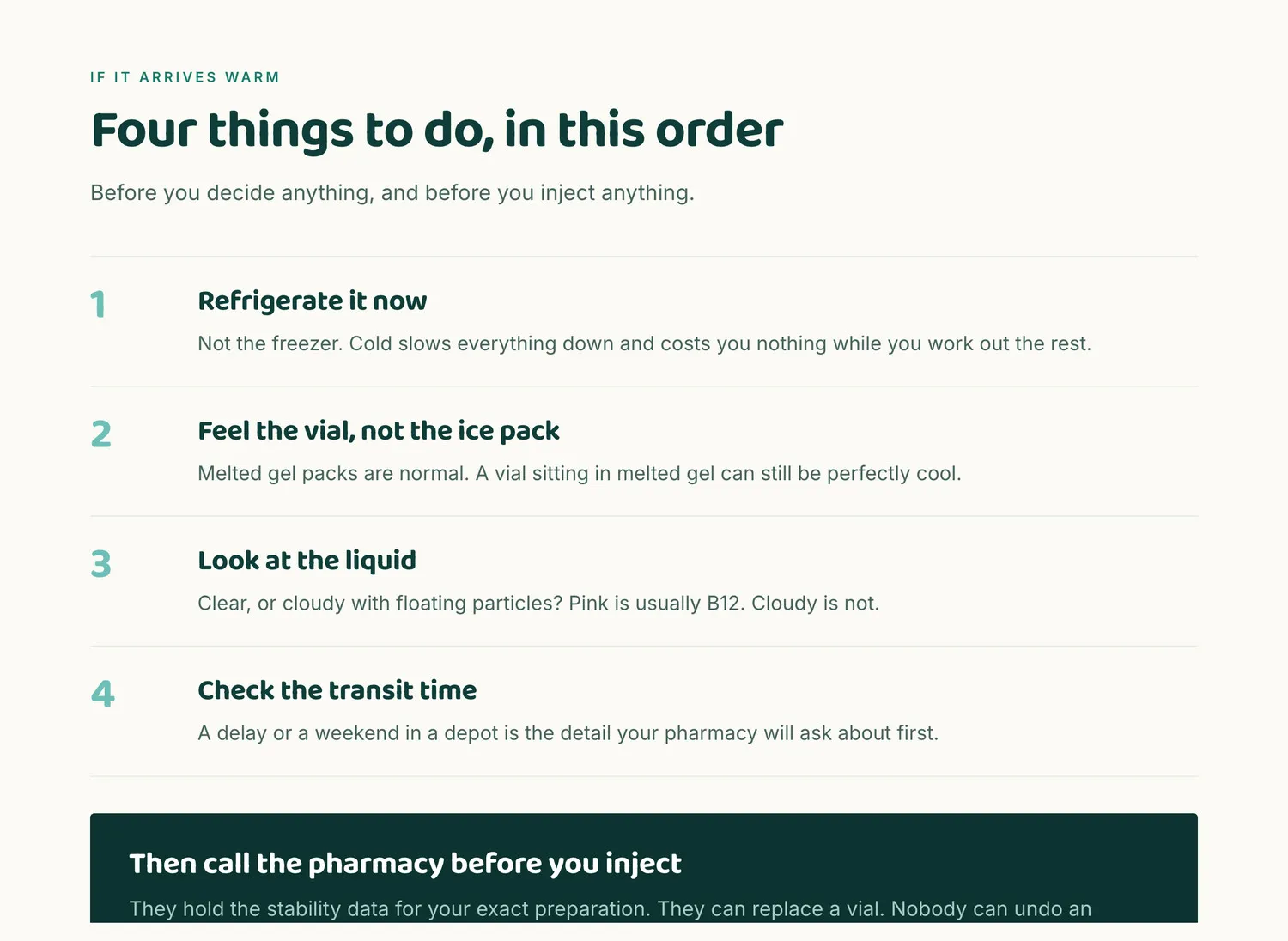
Put it in the refrigerator. Not the freezer. Whatever has already happened in transit, cold slows everything down, and you lose nothing by getting it cold while you work out the rest.
Then look at three things, because your pharmacy will ask about all of them:
- Does the vial still feel cool, or is it at room temperature, or genuinely warm?
- Is the liquid clear, or has it gone cloudy, or are there particles floating in it?
- How long was the package in transit, and does the tracking show a delay or a weekend sitting in a depot?
Then call the pharmacy or your provider before you inject anything. This is the whole answer, and everything below is really just context for it. A pharmacy can replace a vial. Nobody can undo an injection.
Melted ice packs are normal, and mean less than you think
Gel packs in a medication shipment are not there to arrive frozen. Their job is to hold the inside of the box cool for the length of the journey, and they do it by melting. A pack that is still solid on arrival means the box was quick or cold. A pack that has turned to liquid means it did its job for as long as it could.
So a melted pack, on its own, is not evidence of anything. It is the vial that matters. A vial sitting in melted gel can still be perfectly cool, because the water absorbed the heat instead of the medication.
What is worth noticing is the combination. Melted packs plus a vial that is warm to the touch plus a long delay in the tracking is a different picture from melted packs plus a cool vial delivered on time. Tell the pharmacy which one you have.
If it froze, that one is simple
Freezing is the single storage question with a clear, universal answer, and it goes the other way from what people expect.
Do not use a vial you believe has frozen, even if it thawed and looks completely normal.
Semaglutide is a peptide, and freezing damages peptide medications in ways that do not show up as anything you can see. Molecules clump together, the liquid still looks fine, and the medicine underneath may not be. This is why the labeling for the FDA-approved semaglutide pens instructs patients to discard any pen that has been exposed to freezing temperatures, regardless of appearance, and the same caution applies to a compounded vial.
It catches people out in ordinary ways. A vial pushed to the back of a fridge against the cooling plate. Domestic fridges running colder than their dial claims. Or a winter delivery left on a doorstep overnight. If you think it froze, call the pharmacy and say so.
Why nobody online can tell you how many hours you have
This is the part almost every article skips, and it is the reason the confident numbers are a trap.
A stability figure is not a property of semaglutide in the abstract. It is a property of one specific preparation, made by one specific pharmacy, to one specific formula. Change what else is in the vial and the answer changes with it.
Compounded preparations vary in ways that directly affect how they behave out of the fridge, and the FDA has flagged that variability as one of its concerns with compounded GLP-1 products. Concentration differs between pharmacies. Some contain vitamin B12, which is why some vials are pink. Preservative systems differ, which changes how long a vial survives once you puncture it. Container and stopper differ. Each of those shifts the numbers.
So when a telehealth company publishes “stable up to 95 degrees for four days,” that may well be accurate, and it may have come straight from their pharmacy’s own stability testing. It still says nothing reliable about a vial compounded somewhere else to a different formula. Applying their number to your medication is guesswork wearing a lab coat.
We will not publish a number either, and we want to be plain about why. We would be telling you that something is safe to inject based on data we do not hold. The pharmacy that compounded your vial has that data. We would rather point you at them than sound more certain than we are.
What the approved pens say, and why yours may differ
The FDA-approved semaglutide products have published storage parameters, and they are useful background even though they do not govern a compounded vial. According to the manufacturer’s storage and stability information, for the approved pens:
- Before first use, pens are refrigerated at 36 to 46°F (2 to 8°C), and must not be frozen.
- After first use, an Ozempic pen may be kept refrigerated or at room temperature for up to 56 days.
- Unopened Wegovy may be kept unrefrigerated for up to 28 days between 46 and 86°F.
- Any pen exposed to freezing must be discarded, even if it looks normal.
Read those and one thing stands out. Even for a single manufacturer turning out standardized products to one formula in one factory, the answer shifts depending on the product and on whether someone has used it yet. That is precisely why a compounded vial, made to a different formula in a different pharmacy, needs its own answer rather than a borrowed one.
Use the branded figures as a sense of the shape of the thing. Do not use them as permission.
Left out of the fridge overnight
The most common version of this: you took it out to warm up before injecting, got distracted, and found it on the counter the next morning.
The honest answer is that it depends on three things nobody on the internet knows about your vial. How warm the room actually was. How long it truly sat there. And what your particular preparation tolerates, which is the pharmacy’s number, not ours.
What we can give you is the right way to handle it:
Refrigerate it now. Then work out an honest estimate of how long it was out and roughly how warm the room was, because “overnight in a cold apartment in February” and “overnight in a kitchen in August” are different events. Look at the liquid for cloudiness or particles. Then call the pharmacy with those three facts. They will either clear it or replace it, and both of those outcomes are better than guessing.
One thing not to do: do not decide it is fine because a forum thread said so. Reddit does not know your formulation, and the person answering confidently at 2am has a different vial from a different pharmacy.
How to store compounded semaglutide properly
Prevention is duller than diagnosis but it saves the panic.
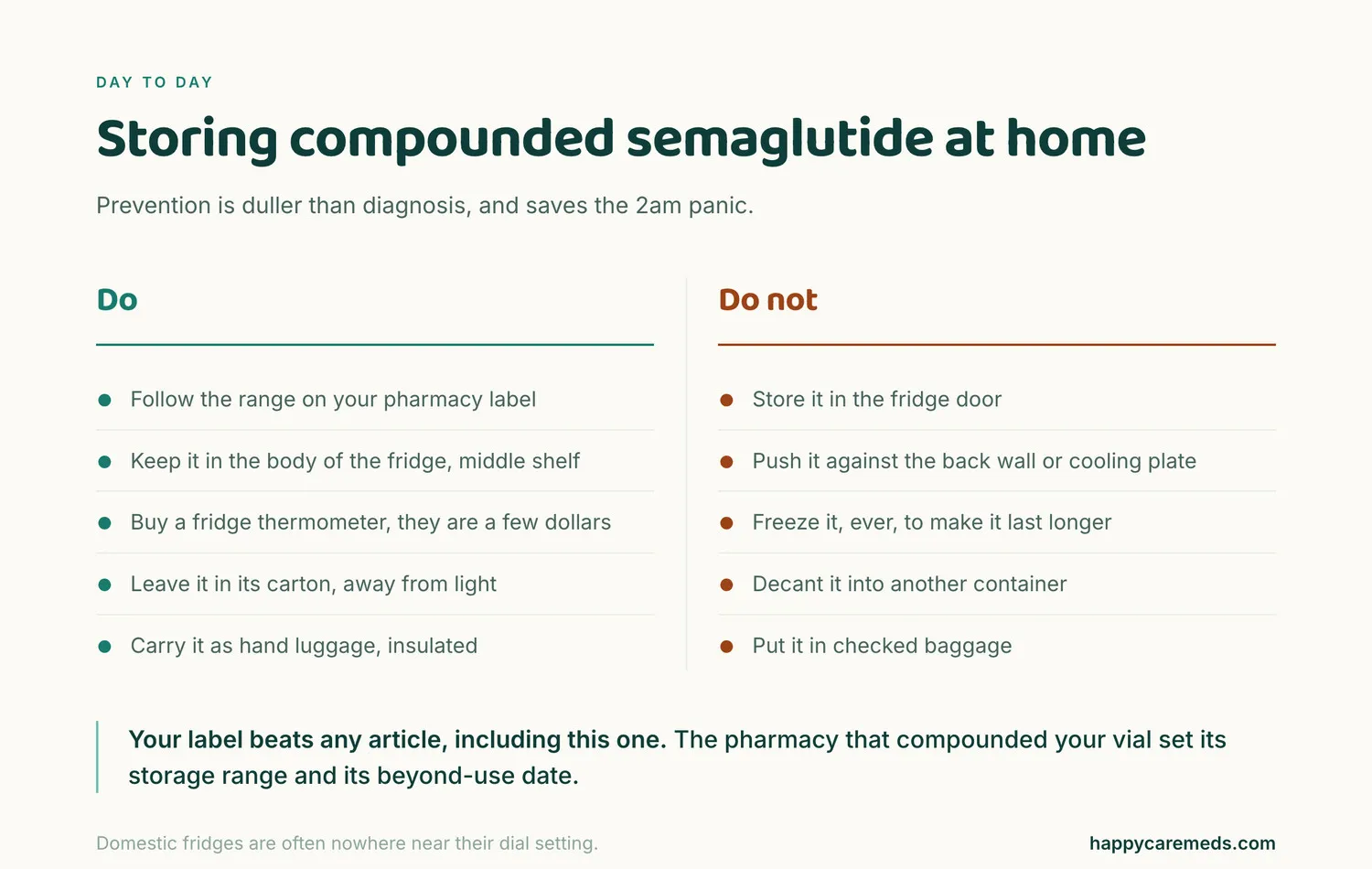
Follow the label, not an article. Your pharmacy label carries the storage range and the beyond-use date for your specific preparation. It beats anything written here, including the branded figures above.
Keep it in the body of the fridge. Not the door, where the temperature swings every time it opens, and not against the back wall or the cooling plate, where things freeze. Middle shelf, towards the front.
Buy a fridge thermometer. They cost a few dollars and domestic fridges are frequently nowhere near their dial setting. If you are storing an injectable at home, knowing the real temperature is worth the small outlay.
Keep it in its carton, away from light, and do not decant it into anything else.
Plan around deliveries. If a shipment is arriving, try not to have it sit on a doorstep in a heatwave or overnight in a freeze. Where a service offers a delivery window or a hold, use it.
Traveling? Take it as hand luggage in an insulated case, never in checked baggage, where the hold can drop below freezing. Bcall the pharmacy label so it is identifiable.
Expired, or past the beyond-use date
Compounded preparations do not carry a manufacturer’s expiry date the way a mass-produced drug does. They carry a beyond-use date. The pharmacy assigns it, based on the preparation, the storage conditions and the standards it works to. It is usually much shorter than a commercial expiry, and it is one of the things worth checking when you verify any compounded prescription.
There is also often a second, shorter clock that starts when the vial is first punctured. Your label or paperwork should tell you both.
Past either date, the answer is the same as everywhere else in this article. Do not inject it on the assumption that a few days will not matter, and do not throw it away assuming it is worthless either. Call the pharmacy. They set the date and they can tell you what it means.
What we do about it
State-licensed United States 503A compounding pharmacies fill our prescriptions, and the pharmacy that compounds your medication sets its storage range and beyond-use date, not us. That is why we keep pointing you back to them rather than publishing a number of our own.
If your medication arrives and something looks wrong, contact us and we will tell you which pharmacy filled your prescription and help you reach them. That pharmacy is also identified on your shipping paperwork and on the vial label, so you can go direct if you would rather.
Every order runs through a consultation with a licensed provider licensed in your state, and our preparations arrive ready to inject rather than as a powder for you to mix. The same handling rules apply across our weight loss treatments and our peptide treatments, since both are refrigerated injectables compounded to order.
Our compounded semaglutide is not FDA-approved, and we say so plainly rather than leaving you to work it out.
If you want the wider version of how to check any provider in this category, including us, that is written up separately: six checks to run before you inject.
Frequently asked questions
My semaglutide arrived warm. Is it still good?
Possibly, but nobody can tell you from a distance. Refrigerate it, note whether the vial itself feels warm or merely not-cold, check the liquid for cloudiness or particles, then call the pharmacy that compounded it with those details and the transit time. They hold the stability data for your specific preparation and can either clear it or replace it.
The ice packs were melted when it arrived. Does that mean it is ruined?
No. Gel packs are designed to melt as they absorb heat during transit, and arriving melted is normal rather than a failure. What matters is the temperature of the vial itself and the condition of the liquid, not the state of the packs.
I left my semaglutide out of the fridge overnight. Can I use it?
Refrigerate it now, then ask the pharmacy. The answer depends on how warm the room was, how long it was really out, and what your particular formulation tolerates, and that last figure varies between pharmacies. Do not rely on a number from another company’s website or a forum, because those describe different preparations.
Does compounded semaglutide need to be refrigerated?
Follow the storage instructions on your pharmacy label, which are specific to your preparation. Compounded semaglutide is generally refrigerated, but the exact range and the beyond-use date are set by the pharmacy that made it rather than by a general rule.
What if my semaglutide froze?
Do not use it, even if it thawed and looks completely normal. Freezing damages peptide medications invisibly. The labeling for the FDA-approved semaglutide pens instructs patients to discard any pen exposed to freezing regardless of appearance, and the same caution applies to compounded vials. Contact the pharmacy for a replacement.
How long can compounded semaglutide stay at room temperature?
There is no single answer, and be wary of any site that gives you one without knowing your vial. Stability depends on the concentration, what else is in the preparation, the preservative system and the container, all of which vary between pharmacies. Your pharmacy holds the figure for your preparation.
My semaglutide looks cloudy. What now?
Do not inject it. Cloudiness, floating particles or visible sediment are a different matter from color and warrant a call to the pharmacy. Note that a pink or red tint is usually vitamin B12 in the formulation rather than a fault.
What is a beyond-use date?
It is the date a compounding pharmacy assigns to a preparation, based on the formulation, storage conditions and the standards it works under. It is typically much shorter than a commercial expiry date, and there is often a second, shorter period that begins once the vial is first punctured.
Can I store it in the freezer to make it last longer?
No. Freezing damages the medication rather than preserving it, and a frozen vial should not be used even after thawing.
Where in the fridge should I keep it?
The body of the fridge, middle shelf towards the front. Avoid the door, where temperature swings with every opening, and avoid the back wall or cooling plate, where items can freeze. A cheap fridge thermometer is worth having, because domestic fridges often run well away from their dial setting.
Published 12 August 2026 by Happy Care Meds. We update this article when FDA guidance changes.
This article is general information about medication storage and handling. It is not medical advice, it does not tell you whether any particular vial is safe to use, and it does not describe expected results from any medication. Always follow the storage instructions on your pharmacy label, and contact your pharmacy or a licensed provider about your specific medication.
Sources: Novo Nordisk product storage and stability information for GLP-1 receptor agonists; U.S. Food and Drug Administration statements on compounded GLP-1 medications and on dosing errors with compounded injectable semaglutide; United States Pharmacopeia chapters 795 and 797 on compounding and beyond-use dating.