
The pharmacy that compounded your semaglutide has a name, an address, and a state license you can look up in about two minutes. The active ingredient in it came from a specific manufacturer, and the FDA now runs an import list controlling which of those are allowed into the country at all. If the company selling to you will not answer those questions, you have your answer already. Here are six checks you can run yourself.
Key takeaways
- Compounded semaglutide is not Ozempic or Wegovy, is not FDA-approved, and is not a generic. There is currently no generic semaglutide.
- The pharmacy that made yours has a name and a state license you can verify in about two minutes. A company that will not name it has answered your question.
- The FDA’s concerns are mostly about sourcing and handling: salt forms of semaglutide, improperly imported ingredient, counterfeits, and dosing errors.
- Six questions settle it: who compounds it, is the license current, base or salt form, where the ingredient was made, what testing was run, and whether a licensed provider wrote the prescription.
- Pink or red usually means vitamin B12, not a counterfeit. Cloudiness or floating particles is a different matter, and a real one.
Why sourcing is the real question
Most people start with “is compounded semaglutide safe?” The trouble is that this isn’t one product. It’s a category. Two vials with identical labels can come from a state-licensed US pharmacy under board supervision, or from an anonymous seller shipping powder marked “research use only.” The same question has two very different answers depending on which one landed on your kitchen table.
The FDA has been unusually blunt about this, and what it keeps returning to is not compounding itself. It’s where the drug substance came from and who handled it along the way.
On salt forms, the agency has reported that some compounders may be using semaglutide sodium and semaglutide acetate. In its own words, the approved drugs contain the base form of semaglutide, while these salt forms are different active ingredients. The FDA has said it is not aware of any lawful basis for using them in compounding, and that they have not been shown to be safe or effective. We go through this in more detail, along with the rest of the formula, in what is actually in compounded semaglutide.
On imported ingredients, the FDA operates an import alert covering GLP-1 active pharmaceutical ingredients. Material from manufacturers it has not verified can be detained at the border.
It has also warned about dosing errors with compounded injectable semaglutide, including doses drawn in the wrong units or at a concentration the patient wasn’t expecting. And both the FDA and the WHO have flagged counterfeit product reaching patients, including fake versions of the branded pens.
Look at that list again. Almost every item is a sourcing or handling failure rather than a compounding failure. Which means the useful thing to do isn’t to form a view about compounding in the abstract. It’s to find out where your particular vial came from, and that turns out to be a question with a real answer.
Is compounded semaglutide the same as Ozempic or Wegovy?
No, and a company that tells you otherwise is misleading you.
Ozempic and Wegovy are FDA-approved finished products. One manufacturer, sealed standardized presentations, an approved dose schedule, and a package insert the FDA has reviewed.
A compounded preparation is made by a pharmacy against an individual prescription. It is not FDA-approved. It isn’t a generic either, because generics go through their own FDA approval process and there is currently no generic semaglutide. Concentration can differ. Presentation can differ. How the dose is measured can differ, and so can what else is in the vial.
That last point isn’t academic. The FDA’s dosing-error alert exists precisely because compounded vials aren’t standardized the way a branded pen is. Concentrations vary between pharmacies, and a dose written in “units” on one vial may not mean the same volume as on another.
So there are things you’re entitled to ask, and any legitimate provider will answer them without going quiet:
- Which form of the active ingredient is used, base or a salt form
- What concentration the vial is, and whether your dose is measured in milligrams or units
- What else is in the vial besides semaglutide
- Which pharmacy compounded it
The Alliance for Pharmacy Compounding, which is the compounding industry’s own trade body, says that advertising a compounded drug under a brand name such as “compounded Ozempic,” or describing a compounded drug as FDA-approved, are illegal claims. If a company selling to you does either of those things, it has told you something about how carefully it operates.
What “compounded” actually means
A compounded medication is prepared by a pharmacy for one specific patient, rather than mass-produced and sold in a sealed, FDA-approved package.
Here is the part that surprises people: the FDA does not review compounded drugs for safety, effectiveness, or quality before they are marketed. That isn’t a scandal or a loophole. It’s how compounding has always worked, and the agency says so openly. What fills the gap isn’t federal pre-approval but a different system of oversight, and it comes in two forms that get mixed up constantly.
503A compounding pharmacies
A 503A pharmacy compounds against an individual prescription for an individual patient. Its license and inspections come from a state board of pharmacy. For anything sterile, which includes anything injectable, it works to United States Pharmacopeia standards, mainly USP <795> and USP <797>. Those chapters govern how preparations are made, tested, dated, and documented.
Most compounded semaglutide from a legitimate US telehealth service comes from a 503A pharmacy.
503B outsourcing facilities
A 503B outsourcing facility is a different animal. It registers directly with the FDA, is inspected by the FDA, can compound in batches without a patient-specific prescription, and must follow cGMP, or current Good Manufacturing Practice.
503A vs 503B: which is better
Neither one is “the good one.” They’re built for different jobs. (We have written a fuller explainer on what 503A and 503B actually mean and how to check which one made your medication.) A 503B facility exists for batch production, a 503A pharmacy for patient-specific preparation. The genuine risk is an offshore supplier that belongs to neither category and answers to nobody.
Where this gets abused in marketing is cGMP, so it’s worth being precise, because very few companies are. The manufacturer of the active ingredient operates under cGMP, and that is what the FDA’s import alert assesses. A 503B outsourcing facility operates under cGMP for its compounding. A 503A pharmacy does not. It works under state board licensure and USP <795> and <797>.
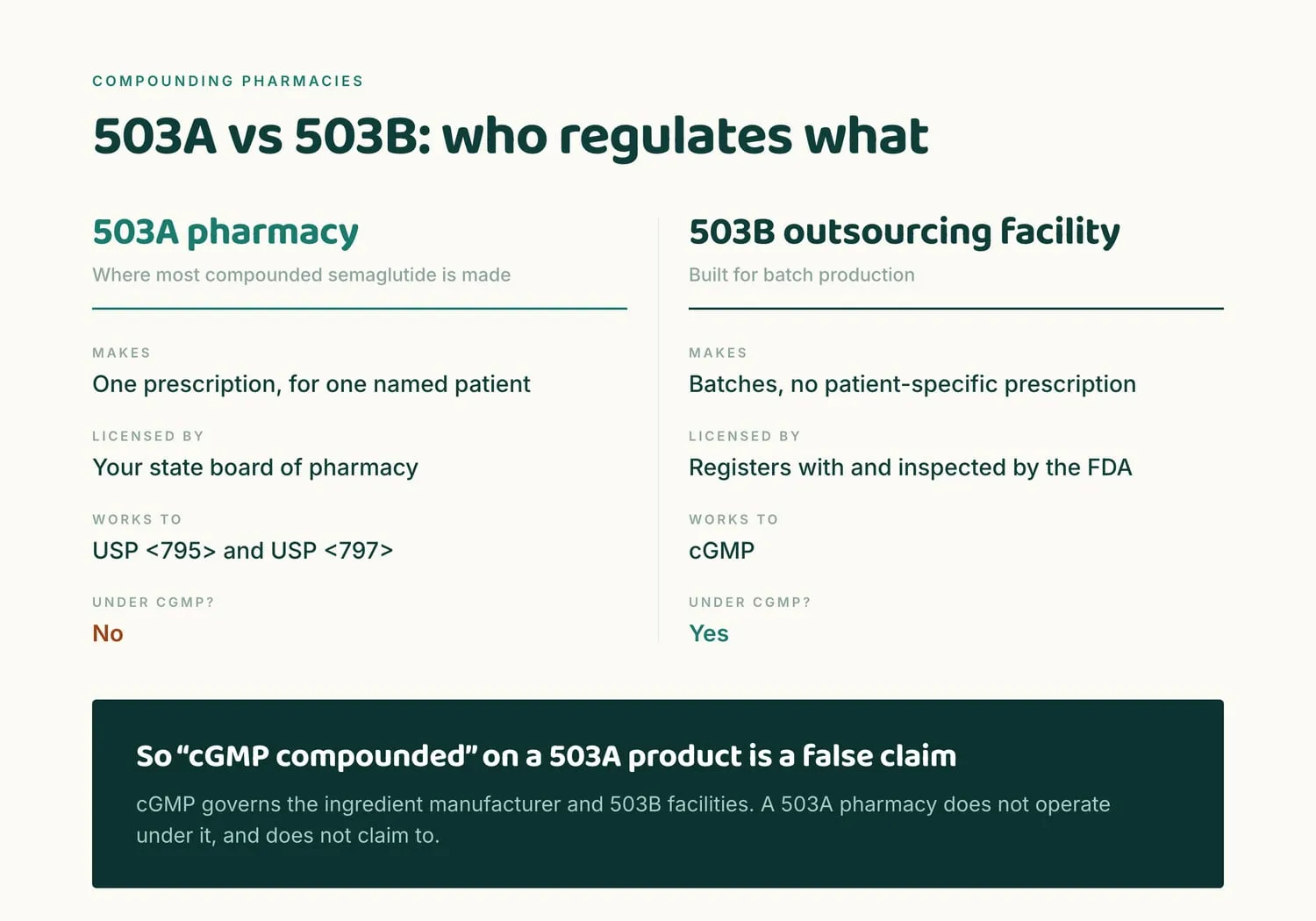
So when a company advertises that its 503A-compounded preparation is “made under cGMP,” it is claiming a standard its own pharmacy doesn’t operate under and doesn’t itself claim. That isn’t a bit of marketing gloss. It’s a false statement about regulatory status, and it’s one of the more reliable signs that a seller isn’t paying attention.
The six checks
None of these need any expertise, and all of them can be done before you spend a penny.
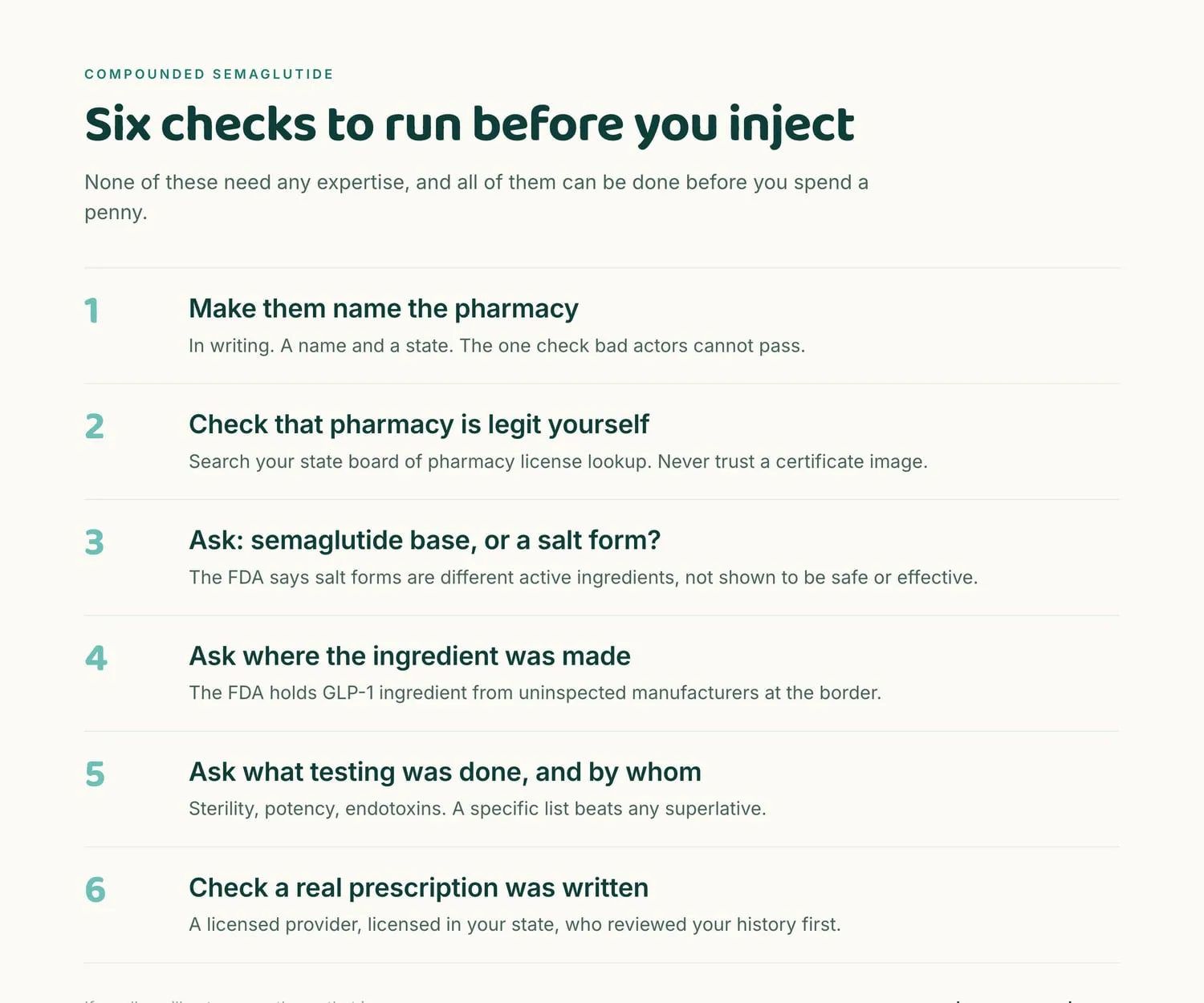
1. Make them name the pharmacy
Ask, in writing, which pharmacy compounds the medication. Get a name and a state.
This one check does most of the work, because it’s the one bad actors can’t pass. A company sending prescriptions to a licensed US pharmacy has no reason to be cagey about which one. A company that answers with “our network of partner pharmacies,” or “a licensed facility,” or simply doesn’t answer, has told you what you needed to know.
It’s easier than it sounds, too. Legitimate operations usually disclose the fulfilling pharmacy somewhere in their terms or shipping information, and the pharmacy’s name normally turns up on the vial label and the shipping paperwork when your medication arrives. If the name on the vial isn’t one anybody ever mentioned to you, make a phone call before you inject anything.
2. Check the pharmacy is legit yourself
Once you have a name, verify it independently. Don’t accept a certificate image on a website, because those take about five minutes to fake.
Every state board of pharmacy publishes a license lookup. Search for “[state] board of pharmacy license verification,” or use the Alliance for Pharmacy Compounding’s state license checker. You’re checking three things: that the pharmacy exists, that its license is current, and that it isn’t carrying disciplinary action.
Beyond that, the National Association of Boards of Pharmacy runs verification and accreditation programs, including its Compounding Pharmacy Accreditation and the .pharmacy domain program. PCAB accreditation is generally treated as the strongest voluntary credential a compounding pharmacy can hold. LegitScript certifies healthcare merchants and pharmacies and publishes a lookup anyone can search. Worth knowing that Google and Meta both require LegitScript certification before a company can advertise in this category at all, which makes it a floor rather than a badge of honour.
Two minutes of searching and you either find a live license record or you don’t.
3. Ask whether it’s semaglutide base or a salt form
Hardly anyone knows to ask this, and it’s the thing the FDA has been loudest about.
The question is simple. Is this semaglutide base, or a salt form such as semaglutide sodium or semaglutide acetate?
The FDA’s position is that the approved drugs contain the base form, that the salt forms are different active ingredients, that it isn’t aware of any lawful basis for using them in compounding, and that they haven’t been shown to be safe or effective. They ended up in the supply chain largely because they were easy to buy from suppliers selling into the “research chemical” market.
A pharmacy that sources carefully will answer this immediately and without any discomfort. A seller who doesn’t engage with the question isn’t paying enough attention to be trusted with something you inject.
One related warning sign is worth treating as final: any product described anywhere as “research use only” or “not for human consumption.” That isn’t a legal technicality. It’s the supplier stating in writing that the material was never meant to go into a person.
4. Ask where the active ingredient was manufactured
This one is newer, and almost no seller expects it.
The FDA runs an import alert covering GLP-1 active pharmaceutical ingredients, alongside what it calls a “Green List” of API manufacturers it has inspected and found to be working in line with its standards. Material arriving from manufacturers that aren’t on the list can be detained at the border without examination.
Why should you care? Because the raw semaglutide in any compounded preparation is made by an API manufacturer, often outside the United States, and that is completely normal and lawful when the manufacturer has been inspected by the FDA. A US pharmacy compounding with improperly imported ingredient is the exact failure this system was built to stop.
So the question worth asking is whether your pharmacy sources its semaglutide API from an FDA-inspected manufacturer, consistent with the GLP-1 import alert.
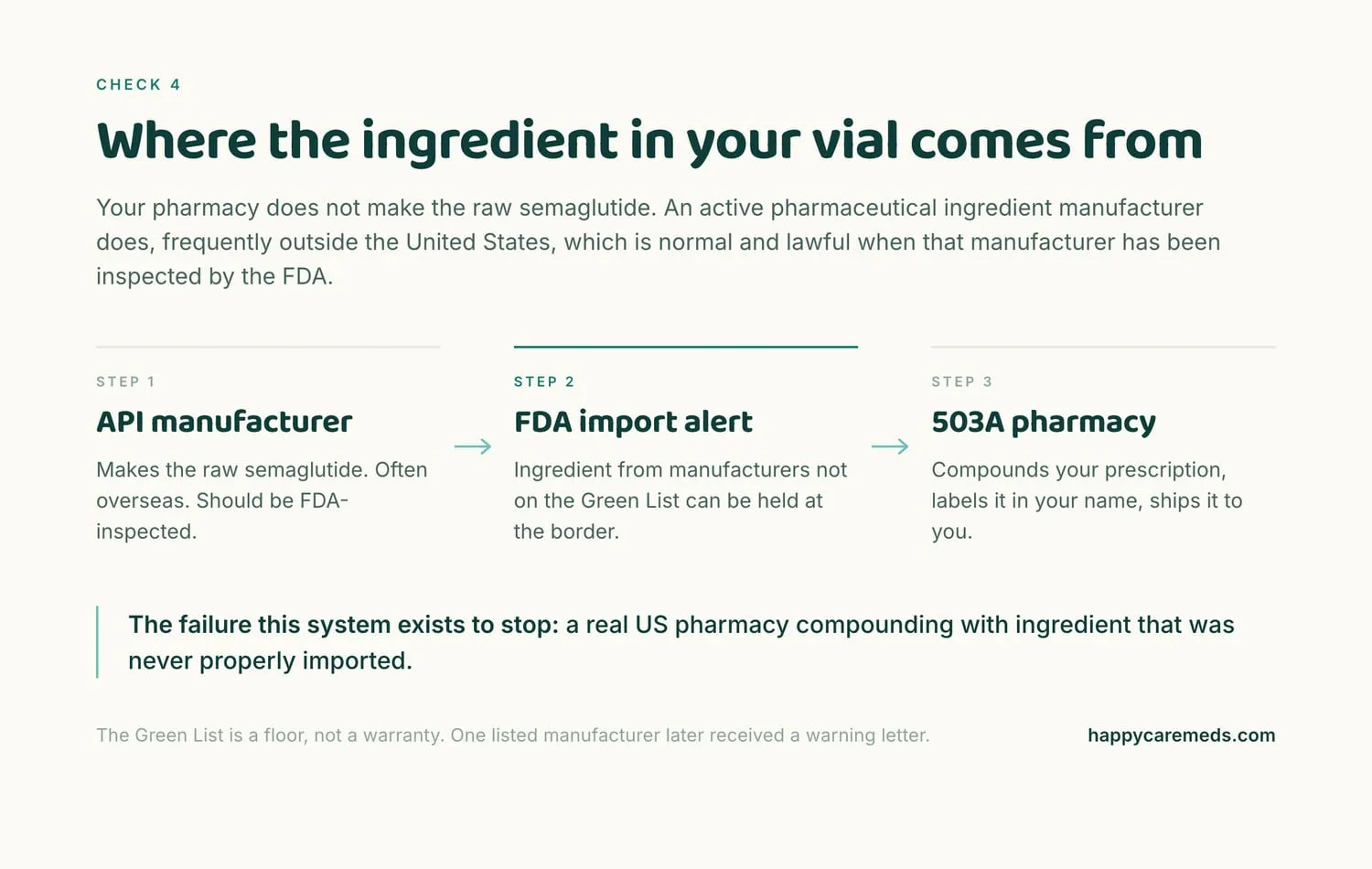
One honest caveat, because the list gets oversold. The Green List is a floor, not a warranty. At least one manufacturer that was initially included later received an FDA warning letter. It tells you a supplier has been inspected. It doesn’t promise nothing will ever go wrong. Treat it as one signal among the six here.
5. Ask what testing was done, and by whom
Compounding pharmacies that take sterile preparation seriously send finished product out for third-party analytical testing. What gets tested varies, and the specifics matter far more than the reassurance.
Sterility testing confirms the preparation is free of microbial contamination, which is non-negotiable for anything injected. Potency testing confirms the vial contains the amount of active ingredient the label states. Endotoxin testing looks for bacterial breakdown products that survive sterilization and can still provoke a reaction even when nothing living remains.
Ask which of those are run, and whether the testing is in-house or third party. Third party is stronger. Pay attention to the shape of the answer, too. A specific list of assays beats a superlative every time. “Tested for sterility, potency and endotoxins by an independent lab” tells you something real. “Highest quality, rigorously tested” tells you nothing at all.
6. Check how the prescription was written
Sourcing isn’t only about the pharmacy. It’s also about whether a real clinical decision ever happened.
A compounded prescription medication should involve a licensed provider who reviews your health history, works out whether the medication is appropriate for you, and writes a prescription for you specifically. That provider should be licensed in your state.
If you can drop an injectable prescription medication into a shopping cart and check out without any of that taking place, no amount of pharmacy quality repairs what has already gone wrong. The prescription isn’t paperwork. It’s the step where somebody qualified decides whether you should be taking this in the first place.
What fake or mis-sourced semaglutide looks like
People ask what fake semaglutide looks like, hoping there’s a visual tell. Usually there isn’t one, which is exactly why the six checks matter more than squinting at a vial. There are still a few things worth noticing when a package turns up.
Start with the label. A compounded preparation from a legitimate pharmacy will typically carry your name, the prescribing provider, the drug and its concentration, a lot or reference number, and a beyond-use date. Missing your name, no concentration stated, no pharmacy identified anywhere, or a handwritten label are all worth querying before you use it.
Then the packaging. Storage requirements vary between formulations, so there is no single rule that applies to every vial. If yours arrived warm, we wrote a separate guide on what to check before you inject it. What matters is whether the medication arrived the way your pharmacy said it would. If they told you to expect insulated packaging with cold packs and it turned up warm in a padded envelope, that’s a conversation to have with them before you inject. If you were never told what to expect, ask.
Look at what you were actually sold, as well. If you received a powder to reconstitute yourself, with the mixing and the dosing left to you, that isn’t how a patient-specific prescription is normally dispensed to a patient. That pattern belongs to the grey market.
And look at where it came from. International shipping, customs paperwork, or a return address that matches no pharmacy anyone ever mentioned to you are all good reasons to stop and ask questions.
Why is my semaglutide pink or red?
This worries people more than almost anything else, so let’s deal with it directly. Color on its own is not evidence of a fake.
Compounded preparations sometimes include vitamin B12, also called cyanocobalamin, which is a deep red. Add even a small amount to a clear solution and the result can look anywhere from pale pink to properly red. That’s a formulation choice, not a defect.
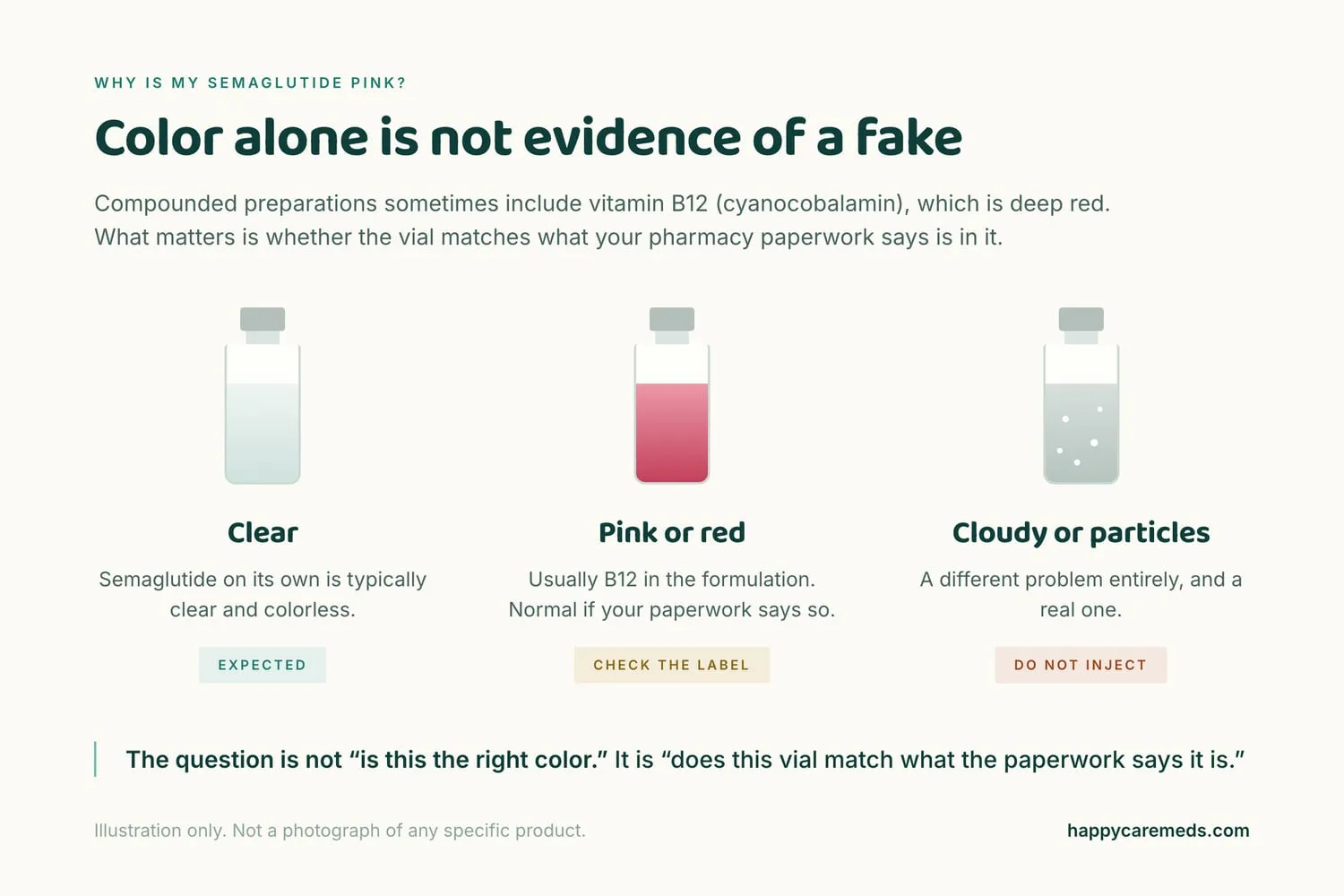
It’s worth knowing that FDA-approved semaglutide pens should be clear and colorless. If a branded pen looks pink or red, something is wrong and you should stop. For a compounded vial, the color depends on what’s actually in it.
What matters is whether the color is expected. If your paperwork accounts for it, that’s normal. If nobody mentioned it, or the color changed between refills and nobody warned you, ring the pharmacy and ask what’s in the vial before you use it. Cloudiness, floating particles or visible sediment are a separate matter and a more serious one: don’t inject it, and contact the pharmacy.
The instinct to develop isn’t “is this the right color.” It’s “does this vial match what the paperwork says it is.” That’s a question you can actually answer.
Red flags, condensed
Any one of these on its own is reason enough to walk away.
Shopping for tirzepatide instead? The same checks apply, and we cover them in where to buy tirzepatide legally and safely.
- No prescription required, or a “consultation” that nobody reviews
- The pharmacy is never named, or the name changes depending on who you ask
- “Research use only” or “not for human consumption” anywhere on the product or the site
- Sold as a powder you reconstitute and dose yourself
- Ships from outside the United States
- A label with no patient name, no concentration, or no pharmacy identified
- Priced far below every legitimate option. Sterile compounding, testing and clinical oversight all cost money, and well below that floor something has been taken out
- No US address, no phone number, and no named medical leadership
- cGMP claimed for a 503A preparation, or “compounded Ozempic,” “generic Ozempic,” “same as Wegovy,” or “FDA-approved” used about a compounded product. The trade body treats the brand-name and FDA-approved versions as illegal claims
- Payment only by cryptocurrency or bank transfer
What we do
Here is our side of it, limited to what we can actually back up.
Our prescriptions are filled by state-licensed US 503A compounding pharmacies, working under state board of pharmacy oversight.
We will tell you which pharmacy. Ask us and we will name the pharmacy filling your prescription. It’s also identified on your shipping paperwork and on the vial label when your medication arrives, so you can check it against your state board yourself, exactly as the first check above describes.
Everything is prescription only and patient specific. Every order requires a consultation with a licensed provider who is licensed in your state. Nothing is sold over the counter, and if a provider decides the medication isn’t appropriate for you, it isn’t dispensed.
Our preparations arrive ready to inject. You’re never asked to reconstitute powder or work out your own dose.
Happy Care Meds holds LegitScript certification, which you can verify through LegitScript’s own public lookup rather than taking our word for it. Our medical director is Dr. Babak Rostami, MD, licensed in California, license number A99776, and that is checkable through the California Department of Consumer Affairs.
Our semaglutide is compounded, so it is not FDA-approved. We say that plainly rather than leaving you to work it out. Compounded medications are not FDA-approved products and we don’t describe ours as one.
We would honestly rather you ran these six checks on us than took any of the above on trust. That’s why they’re written down.
Frequently asked questions
Is compounded semaglutide the same as Ozempic or Wegovy?
No. Those are FDA-approved finished products from a single manufacturer, in sealed and standardized presentations. A compounded preparation is made by a pharmacy against an individual prescription, is not FDA-approved, and is not a generic, because there is currently no generic semaglutide. Any company describing them as equivalent is misrepresenting what it sells.
Is compounded semaglutide FDA approved?
No. The FDA does not review compounded drugs for safety, effectiveness or quality before they are marketed. Oversight of a 503A pharmacy comes from its state board of pharmacy, together with USP standards for sterile compounding and whatever third-party testing the pharmacy chooses to do.
How do I check if a compounding pharmacy is legit?
Get the pharmacy’s name and state in writing, then look it up in that state’s board of pharmacy license verification tool. Confirm the license exists, is current, and carries no disciplinary action. You can also check NABP accreditation, PCAB accreditation, and the LegitScript lookup.
What is the difference between a 503A and a 503B pharmacy, and which is better?
A 503A pharmacy compounds for individual patients against individual prescriptions, is licensed by a state board of pharmacy, and works under USP <795> and <797>. A 503B outsourcing facility registers with the FDA, is inspected by the FDA, can compound in batches without patient-specific prescriptions, and follows cGMP. Neither is inherently better, because they’re built for different jobs. Most compounded semaglutide from US telehealth comes from 503A pharmacies.
What is semaglutide sodium, and why does it matter?
It’s a salt form of semaglutide. The FDA has stated that the approved drugs contain the base form, that salt forms such as semaglutide sodium and semaglutide acetate are different active ingredients, that it is not aware of any lawful basis for their use in compounding, and that they have not been shown to be safe or effective. Ask your provider directly which form is used.
What is the FDA Green List?
It’s part of an FDA import alert covering GLP-1 active pharmaceutical ingredients. The list identifies API manufacturers the FDA has inspected and found consistent with its standards, and ingredient arriving from manufacturers not on it can be detained at the border. It’s a floor rather than a guarantee, since at least one listed manufacturer later received a warning letter, but asking whether a pharmacy sources in line with it is a fair and revealing question.
What does fake semaglutide look like?
Usually you can’t tell by looking, which is why verifying the pharmacy matters more than inspecting the vial. The more reliable warning signs are on the packaging rather than in it: no patient name on the label, no concentration stated, no pharmacy identified, packaging that doesn’t match what your pharmacy said to expect, or a powder you’re expected to mix yourself.
Why is my semaglutide pink or red?
Often because the preparation includes vitamin B12, or cyanocobalamin, which is deep red. Color by itself is not evidence of a counterfeit. FDA-approved pens should be clear and colorless, so color in a branded pen is abnormal, while in a compounded vial it depends on the formulation. What matters is whether it matches your pharmacy paperwork. Cloudiness or floating particles are a different and more serious matter: don’t inject, and contact the pharmacy.
How do I find out which pharmacy is making my medication?
Ask the company in writing before you order. When it arrives, check the vial label and the shipping paperwork, since the compounding pharmacy is normally identified on both. Then verify that name against the state board of pharmacy license lookup.
Is cheaper compounded semaglutide a bad sign?
Not automatically. Compounded preparations are often less expensive than branded products and that’s a legitimate difference. But sterile compounding, third-party testing and clinical oversight all cost money, so a price far below every other option usually means one of those three has been removed, and none of them are safe to remove.
What should I do if the pharmacy won’t be named?
Treat it as disqualifying. A licensed US pharmacy is a matter of public record, and there’s no legitimate reason to hide which one is filling your prescription.
Running these checks on us
If you have read this far, the obvious next step is to point the six checks at us rather than take our word for anything. Who we are and who runs the clinical side is written up in full. If you want to know which pharmacy would fill your prescription, ask us and we will tell you. And if you want to see what we actually offer and at what price before speaking to anybody, our compounded semaglutide, weight loss treatments and peptide treatments are all listed openly, with a provider consultation required before anything is dispensed.
Published 12 August 2026 by Happy Care Meds. We update this article when FDA guidance changes.
This article is general information about how compounded medications are sourced and verified. It is not medical advice and does not describe expected results from any medication. Talk to a licensed provider about whether any treatment is appropriate for you.
Sources: US Food and Drug Administration statements on compounded GLP-1 medications, salt forms of semaglutide, the GLP-1 API import alert and Green List, and dosing errors with compounded injectable semaglutide; FD&C Act sections 503A and 503B; United States Pharmacopeia chapters <795> and <797>; National Association of Boards of Pharmacy; Alliance for Pharmacy Compounding; LegitScript.