
Key takeaways
- Usually four things. Most vials hold the drug itself, water, one or two agents that steady the acid and salt balance, and often a preservative. Some also carry vitamin B12.
- The active ingredient is what matters. The FDA says the salt forms, semaglutide sodium and semaglutide acetate, are different active ingredients from the ones in the approved drugs.
- A preservative is normal in a multi-dose vial. The approved multi-dose tirzepatide product holds benzyl alcohol and phenol, so finding one in yours proves nothing bad on its own.
- Check the strength, not just the dose. Milligrams per milliliter is the number behind most compounded dosing errors, and the FDA has logged hospital stays tied to them.
- Your pharmacy holds the answer. It wrote the recipe for your vial, and it can read that recipe back to you if you ask.
Nobody hands you an ingredients list with a compounded prescription. You get a small glass vial, a label with your name on it, and a liquid that is either clear or a startling shade of pink. Search for compounded semaglutide ingredients and you will find very little, because the companies selling it rarely publish the recipe.
What follows is what is normally in that vial. It also covers why two pharmacies can produce different liquids under one product name, and what to ask if you want to know about yours specifically.
Compounded semaglutide ingredients, in one list
A compounded shot is a short recipe, and the pharmacy that made it wrote that recipe down. Most vials hold some mix of these:
- The active ingredient. Semaglutide, sold to the pharmacy as a bulk drug substance. You will also see it called an API.
- Water for injection. Most of the liquid, and a specific grade of water rather than anything from a tap.
- A buffer. Usually a phosphate salt, which holds the acid level steady so the peptide stays intact.
- A tonicity agent. Salt, glycerin or propylene glycol, which brings the liquid closer to the salt balance of your own tissue so the shot stings less.
- A preservative, in most multi-dose vials. Benzyl alcohol, phenol or metacresol are the usual ones.
- Vitamin B12, in some vials but not all. This is what turns the liquid pink.
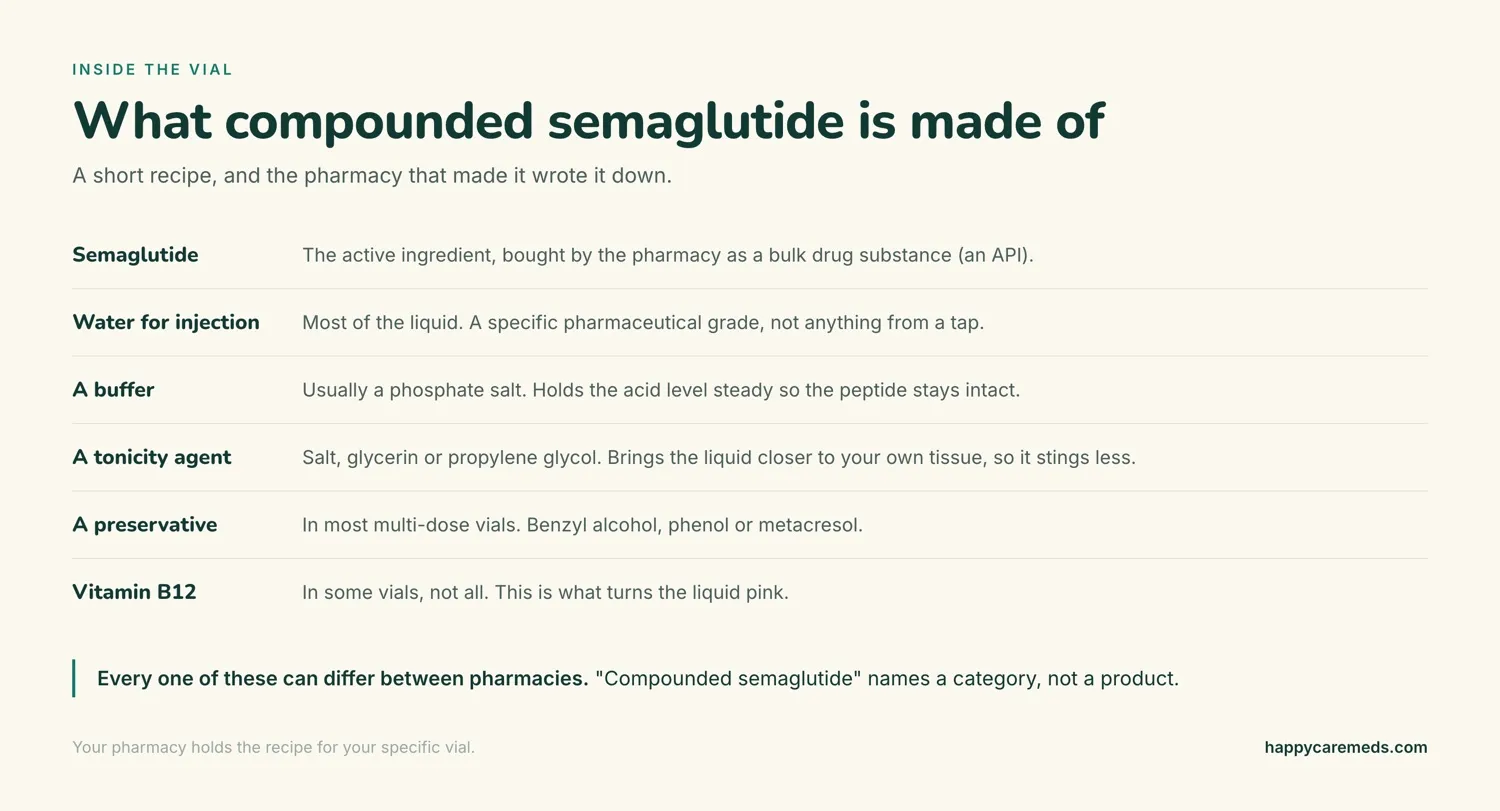
Every one of those can differ between pharmacies, which is the part people tend to miss. “Compounded semaglutide” names a category rather than a product, so the vial your friend has and the vial you have may hold genuinely different liquids.
The active ingredient, and the salt-form problem
The approved medicines use semaglutide base. Some compounders buy a salt form instead, and the two are not the same thing in the eyes of the regulator. The FDA puts it plainly:
“These salt forms, including semaglutide sodium and semaglutide acetate, are different active ingredients than are used in the approved drugs. The agency does not have information on whether these salts have the same chemical and pharmacologic properties as the active ingredient in the approved drug, and we are not aware of any lawful basis for their use in compounding.”
That short paragraph says two separate things. The salt forms are chemically different from what is in Ozempic and Wegovy, and the agency sees no lawful basis for compounding with them at all.
It is also close to impossible to spot from outside. A salt form still gets sold, shipped and labeled as “semaglutide,” and nothing on a website will look wrong to you. The difference lives on the paperwork that travels with the raw ingredient. That is why asking which form your pharmacy uses is one of the few questions that genuinely sorts one provider from another.
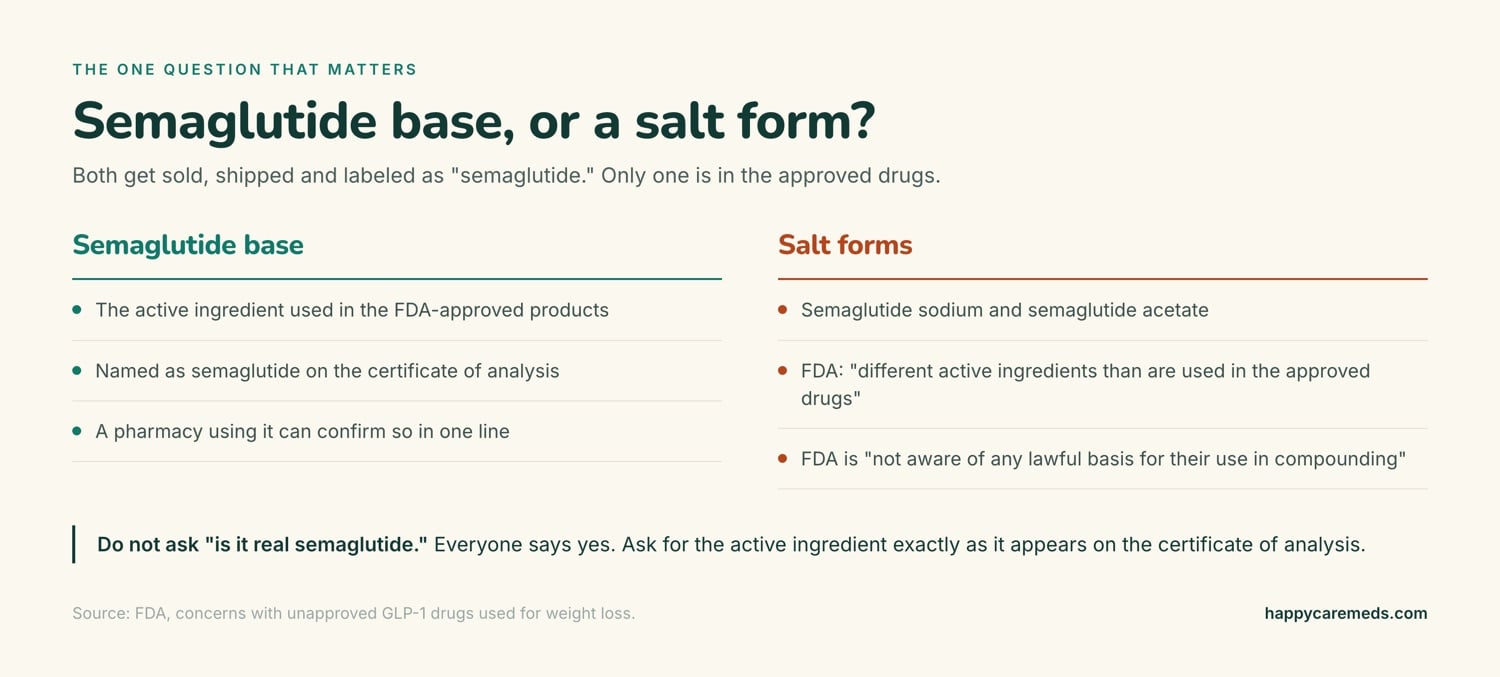
Ask it in a specific way. Do not ask “is it real semaglutide,” because everyone says yes to that. Ask for the active ingredient exactly as it appears on the certificate of analysis. A pharmacy using the base can answer in one line, and anything vaguer than a straight answer is itself informative.
Where the active ingredient was made
The API reaches the pharmacy from a chemical plant, and that plant is often in another country. Plenty of people find that alarming, but on its own it should not be, because lawful import of inspected foreign API is ordinary across the whole drug supply.
What matters is whether the maker has passed an inspection. The FDA now runs an import alert aimed squarely at this, the green list, number 66-80. In its words, the alert helps stop GLP-1 APIs “that have potential quality concerns from entering the U.S. supply chain.” It “does not apply to GLP-1 API from manufacturers that, based on an FDA inspection or other FDA evaluation, appear to be in compliance.” The useful question is therefore not whether your ingredient was made abroad. It is whether the FDA has actually looked at the plant that made it.
This is also the one place in the chain where cGMP genuinely applies. Those standards govern the plant that makes the raw ingredient, and they govern 503B outsourcing facilities. They do not describe a 503A pharmacy filling your individual prescription, which is why a telehealth company advertising “cGMP compounded” is naming something that does not exist.
What the approved products use
Inactive ingredients sound like filler, but they keep the peptide stable and decide how much the shot hurts. You cannot look up your own compounded recipe in a public database. You can look up the approved products, though, and those make a useful yardstick. Both of the labels below are public on DailyMed, the National Library of Medicine’s label database, so you can read them yourself:
| Product | Inactive ingredients per 1 mL |
|---|---|
| Ozempic (semaglutide, multi-dose pen) | disodium phosphate dihydrate 1.42 mg, propylene glycol 14 mg, phenol 5.5 mg, water for injections |
| Ozempic (single-dose syringe) | disodium phosphate dihydrate 1.42 mg, sodium chloride 8.25 mg, water for injection |
| Zepbound (tirzepatide, single-dose, per 0.5 mL) | sodium chloride 4.1 mg, sodium phosphate dibasic heptahydrate 0.7 mg, water for injection |
| Zepbound (tirzepatide, multi-dose, per 0.6 mL) | benzyl alcohol 5.4 mg, glycerin 4.8 mg, phenol 1.08 mg, sodium chloride 1.05 mg, sodium phosphate dibasic heptahydrate 0.8 mg, water for injection |
Two things are worth pulling out of that table. The recipes are short and dull, which is what a good one looks like, and the same drug from the same maker changes with the format. Novo Nordisk uses phenol and propylene glycol in the multi-dose pen and neither of them in the single-dose syringe.
If one maker varies its own recipe that much, a compounded version from a different pharmacy will vary too. That is not a scandal, it is simply why you cannot read a number off somebody else’s label and assume it fits your vial. It is the same reason we refuse to publish storage times we hold no data for.
Why a multi-dose vial needs a preservative
People see “benzyl alcohol” on a label and worry, so look back at the table before you do. The multi-dose Zepbound recipe is an FDA-approved product and it holds both benzyl alcohol and phenol. The Ozempic pen holds phenol. Neither single-dose format holds any preservative at all.
That pattern explains itself once you see it. A preservative exists because you puncture a multi-dose vial more than once, and every puncture is a chance for bacteria to get in. Anything built to be entered again and again needs something in it that holds growth back. A single-dose syringe gets used once and thrown away, so it does not.
Your compounded vial is almost certainly multi-dose, since four weekly shots from one vial is the normal pattern. Expect a preservative in it. Its absence would be the odder finding.
Two practical notes. Benzyl alcohol carries specific cautions in pregnancy and in newborns, so tell your provider if either applies to you. And if you have ever reacted to a preserved shot, say so during your consult rather than after your vial lands, because the pharmacy picks the recipe before it makes the vial.
One related case is worth knowing about. Some sellers ship a powder plus a separate vial of liquid for you to mix, and that liquid is usually bacteriostatic water, which is sterile water already preserved with benzyl alcohol. Mixing your own medicine adds a whole extra class of error, which is a fair reason to prefer something that arrives ready to inject.
Vitamin B12, and why some vials are pink
The pink or reddish tint that alarms so many people is nearly always cyanocobalamin, a form of vitamin B12. It is a deeply red compound, and a little of it in a clear liquid gives you exactly that color. Pharmacies add it because some prescribers ask for it.
The point for this article is narrower. A pink vial and a clear vial are not the same mix, even when both are labeled semaglutide at the same strength, because something extra is in one of them.
If the color changes between refills, ask about it rather than shrug. It may mean nothing more than a change of pharmacy, or it may mean the recipe changed, and either way the pharmacy can tell you in a sentence. We cover this in more depth in the guide to checking whether compounded semaglutide is legitimate.
Cloudiness and floating bits are a different matter. Color is usually an ingredient, whereas cloudiness is not, and it earns a call before you inject. The full version of that, shade by shade, is in why compounded semaglutide turns pink.
The number that matters most
Your label carries a strength, written as milligrams per milliliter, and that number decides how much liquid a given dose actually is. At 2.5 mg/mL a 2.5 mg dose is a full milliliter. At 5 mg/mL the same dose is half that. Same words on the prescription, very different amount in the syringe.
This is not a theoretical worry. The FDA reports “multiple reports of adverse events, some requiring hospitalization, that may be related to dosing errors associated with compounded injectable semaglutide products.” It traces those errors to patients “measuring and self-administering incorrect doses,” and in some cases to health care professionals miscalculating them.
Two things make it worse than it sounds. Compounded vials come in strengths with no approved equivalent, so there is no familiar default to fall back on. People also draw up doses with insulin syringes marked in units rather than milliliters, which invites a conversion slip at exactly the wrong moment.
Do not work any of this out yourself. Your dose in milliliters, or in units if you were given a unit figure, belongs on the paperwork the pharmacy sent, or it comes from your provider. If a refill turns up at a different strength from the last one, stop and check before you draw it up, because the volume you have used for weeks may now be the wrong volume.
What should not be in it
Everything above describes a normal vial. A few things belong nowhere near one.
Retatrutide and cagrilintide. The FDA says both “cannot be used in compounding under federal law.” It adds that they “are not components of FDA-approved drugs and have not been found safe and effective for any condition.” The agency has warned telehealth companies for marketing retatrutide, and warned API distributors for selling it. A company offering you either is not giving you early access to anything.
Anything sold “for research purposes” or “not for human consumption.” The FDA has warned companies selling exactly these. It notes they are “sold directly to consumers for human use with dosing instructions,” and urges people not to buy them. Those words on a label protect the seller. They do not describe what is in the bottle.
A pharmacy name that is not real. The FDA knows of fraudulent compounded semaglutide and tirzepatide where “the compounding pharmacies identified on the labels of the products do not exist.” In other cases the label named a real pharmacy that never made the product. A name on a label is worth something only once you have looked it up in the state board register yourself.
Extra actives you never agreed to. Add-ins beyond B12 do turn up in this market, and anything active in your vial should be on your prescription and known to you before it arrives.
How to find out what is in yours
None of this has to stay a mystery. Three steps, in order.
Read the label and the paperwork first. The vial label carries the pharmacy name, the strength and the beyond-use date, and the insert that came with it often lists the full recipe. People throw that insert away without reading it.
Then call the pharmacy that made it, rather than the telehealth company. The pharmacy holds the recipe for your specific vial and can read it to you, and this is a routine request that pharmacists field constantly.
Ask these five questions, which between them cover everything in this article:
- What is the active ingredient, exactly as written on the certificate of analysis?
- How many milligrams per milliliter is it?
- Which inactive ingredients are in it, including the preservative?
- Does this vial hold B12, or anything else beyond semaglutide?
- What testing was done on this batch, and by whom?
A pharmacy that compounds properly answers all five without friction. Reluctance on the first one is the answer worth paying attention to.
What we do about it
State-licensed United States 503A compounding pharmacies fill our prescriptions, and each pharmacy sets the recipe for what it makes. We do not compound anything ourselves, so we are not going to pretend that we write those recipes.
What we will do is tell you which pharmacy filled your prescription. Ask us and we will name it and help you reach them for the recipe. That pharmacy also appears on your shipping paperwork and on the vial label, so you can go direct if you would rather.
Our vials arrive ready to inject rather than as a powder for you to mix, which removes one of the bigger sources of error described above. Every order runs through a consult with a licensed provider licensed in your state. Your dose comes from that provider and the pharmacy, not from a sum you do at the kitchen table.
Our compounded semaglutide is not FDA approved, and we would rather say that plainly than leave you to work it out. The same goes across our weight loss treatments and our peptide treatments.
The full version of how to check any provider in this category, us included, is written up separately as six checks to run before you inject. If your vial has already landed and something about it looks off, start instead with what to do when medication arrives warm.
Frequently asked questions
What is in compounded semaglutide?
Most vials hold the active ingredient, water for injection, a phosphate buffer to steady the acid level, a tonicity agent such as salt or glycerin, and usually a preservative if the vial is multi-dose. Some also hold vitamin B12, which turns the liquid pink. The pharmacy sets the exact recipe and it varies between them, so the only list that counts is the one your own pharmacy holds.
Is compounded semaglutide the same active ingredient as Ozempic?
That depends on what the pharmacy bought. We compare the two properly in compounded semaglutide against Ozempic. The approved products use semaglutide base. The FDA has said that salt forms, including semaglutide sodium and semaglutide acetate, are different active ingredients from the ones in the approved drugs, and that it is not aware of any lawful basis for compounding with them. Ask for the active ingredient exactly as it appears on the certificate of analysis.
Why is my compounded semaglutide pink?
Almost always vitamin B12, as cyanocobalamin, which is a strongly red compound. There is a whole article on the color question if you want the detail. It is an added ingredient rather than a fault. A color change between refills is still worth a question, because it can mean the recipe or the pharmacy changed.
Does compounded semaglutide contain benzyl alcohol?
Many multi-dose vials do, and that is normal rather than alarming. The FDA-approved multi-dose tirzepatide product holds benzyl alcohol and phenol for the same reason, which is that a vial you puncture several times needs something in it that holds bacteria back. Tell your provider if you are pregnant, breastfeeding, or have reacted to a preserved shot before, since the recipe gets picked before the vial is made.
What is the concentration of compounded semaglutide?
There is no standard strength, which is exactly why it needs checking. Compounded vials appear in strengths with no approved equivalent, and the same milligram dose is a different volume at a different strength. Read the milligrams per milliliter on your label, then confirm your dose in milliliters with the pharmacy or your provider rather than working it out yourself.
Which inactive ingredients are in compounded semaglutide?
Typically a phosphate buffer, a tonicity agent such as salt, glycerin or propylene glycol, water for injection, and a preservative. For comparison, the multi-dose Ozempic pen lists disodium phosphate dihydrate, propylene glycol, phenol and water for injections. A compounded vial follows a similar shape but a different recipe, and the pharmacy can give you the exact list.
Can compounded semaglutide contain retatrutide?
It should not. The FDA says retatrutide and cagrilintide cannot be used in compounding under federal law, adding that they are not components of any FDA-approved drug and have not been found safe and effective for any condition. The agency has warned telehealth companies marketing retatrutide and ingredient distributors selling it.
How do I find out exactly what is in my vial?
Read the label and the insert, then call the pharmacy named on them rather than the telehealth company. The pharmacy holds the recipe and can read it to you. Ask for the active ingredient as written on the certificate of analysis, the strength, the inactive ingredients including the preservative, whether anything beyond semaglutide is in there, and what batch testing was done.
Is bacteriostatic water an ingredient in compounded semaglutide?
Only where a product ships as a powder for you to mix. Bacteriostatic water is sterile water preserved with benzyl alcohol, and it comes as a separate vial to combine with the powder. Something that arrives as a ready-to-inject liquid does not need it, which removes a step where mistakes happen.
Why do two pharmacies produce different-looking semaglutide?
Because “compounded semaglutide” describes a category rather than one product. Strength, buffer, tonicity agent, preservative and any added B12 are all chosen by the pharmacy that makes it. Even one maker varies its own recipe, and the Ozempic multi-dose pen and the single-dose syringe hold different inactive ingredients.
Published 13 August 2026 by Happy Care Meds. We update this article when FDA guidance changes.
This article is general information about how medication is made up. It is not medical advice, it does not tell you whether any product is right for you, and it does not describe expected results from any medication. Always follow the instructions on your pharmacy label, and contact your pharmacy or a licensed provider about your own medication.
Ozempic and Wegovy are registered trademarks of Novo Nordisk A/S. Mounjaro and Zepbound are registered trademarks of Eli Lilly and Company. Happy Care Meds is not affiliated with, endorsed by, or sponsored by either company, and the approved products named here are referred to only to describe their published labeling. Compounded medications are not FDA approved and are not generic versions of any approved drug.
Sources:
- U.S. Food and Drug Administration, “FDA’s concerns with unapproved GLP-1 drugs used for weight loss,” current as of 15 June 2026.
- FDA Import Alert 66-80, the GLP-1 API green list.
- Novo Nordisk prescribing information for Ozempic (semaglutide) injection, via DailyMed.
- Eli Lilly prescribing information for Zepbound (tirzepatide) injection, via DailyMed.
- United States Pharmacopeia chapters 795 and 797 on compounding and beyond-use dating.