
Key takeaways
- Pink almost always means vitamin B12. Cyanocobalamin is a deep red compound, so a small amount of it turns a clear liquid pink.
- It is an added ingredient, not a fault. Some pharmacies put B12 in the same vial. Others do not, so their version stays clear.
- The shade tells you nothing about strength. A darker pink means more B12 in the mix. It does not mean more semaglutide.
- Semaglutide on its own is clear and colorless. The approved product labeling says so, and it tells people not to inject a solution with particles or coloration in it.
- Cloudy is the one to act on. Haze, floating bits or crystals are a call to the pharmacy, not a color question.
You open the box, hold the vial up to the light, and the liquid is pink. Every photo you have seen of this medication showed something clear, so the first thought is usually that something went wrong in transit. So: why is my semaglutide pink, and does it matter?
The answer is duller than the worry. Almost always, nothing went wrong. The color is an ingredient, and which ingredient it is depends on the pharmacy that made your vial. The list of things that really should prompt a phone call is much shorter than people expect.
The short answer
Your semaglutide is pink because it has vitamin B12 in it.
The form used is cyanocobalamin, and it is a strongly red compound in water. Only a small amount goes in, but that is enough to turn the whole vial pink. Shades run from a faint rose through to something close to cranberry juice, and all of that range is normal.
Semaglutide itself adds no color at all. So if your vial is clear, nothing is missing. It simply means your pharmacy made a version without B12 in it. Both versions exist, and neither one is the correct one.
That covers it. The rest of this article is for people who want to know what it means for their own vial. If your question underneath the color question is really whether this is the same medicine as the branded one, we answered that separately in compounded semaglutide compared with Ozempic.
What vitamin B12 is doing in the vial
A compounding pharmacy writes a recipe for each preparation it makes. Some of those recipes include cyanocobalamin alongside the semaglutide, so both go into one vial and you give yourself one shot instead of two.
Pharmacies give a few reasons for combining them. Convenience is the honest one. B12 is also cheap, water soluble, and has a long track record as an injection, so adding it does not complicate the preparation much.
The important part is that this is a choice made by the pharmacy, not a property of semaglutide. We wrote a longer piece on what is actually in a compounded vial, and the short version is that “compounded semaglutide” names a category rather than one product. Two pharmacies can hand you genuinely different liquids under the same words on a website.
Color is simply the one difference you can see without asking anybody.
Does the B12 do anything for you
B12 is often described as helping with the nausea or the tiredness that people report on GLP-1 medications. That claim is common in this industry. It is not something we are going to repeat, because we have not seen evidence that settles it, and we are not in a position to tell you what a vitamin will do in your body.
What is on firmer ground is narrower. B12 deficiency is a real condition with real symptoms, and injectable B12 is a long-established treatment for it. Whether you have that deficiency is a blood-test question for a clinician, not something a vial color can answer.
So treat the B12 as a second ingredient that your provider and pharmacy chose to include. If you want to know why it is in yours, ask them directly. That answer is specific to you, and it beats anything a general article can offer.
Pink, clear, yellow: what each shade means
The practical version, shortest to longest:
- Clear and colorless. Normal. This matches the approved products, which the labeling describes as clear, colorless solutions.
- Pink, rose or red. Normal for a preparation with B12 in it. The depth of the color tracks the amount of B12, and it does not track the amount of semaglutide.
- Faint yellow or straw. Worth one question. Some recipes can look faintly yellow, but plain semaglutide should not, so ask the pharmacy what is in yours before you use it.
- Cloudy, hazy or milky. Do not inject it. Call the pharmacy.
- Anything with visible bits. Do not inject it. Floaters, strands, flakes or crystals all belong in the same bucket.
- Brown, or noticeably darker than it was. Do not inject it. Call the pharmacy.
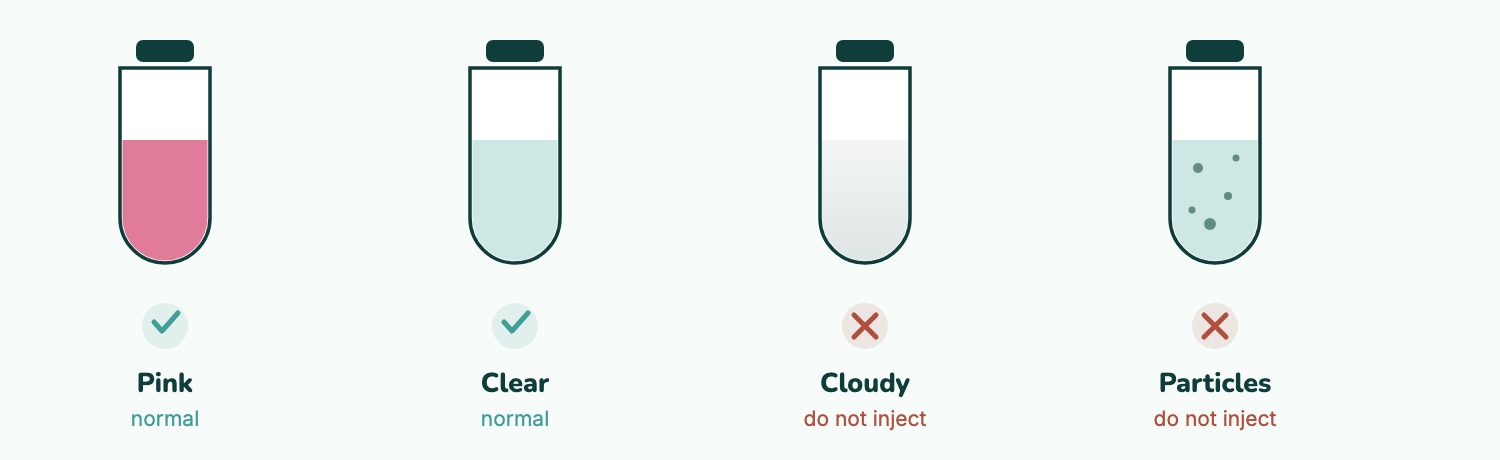
The rule underneath that list comes straight from the approved labeling. Novo Nordisk tells people to inspect Ozempic before use, says it should appear clear and colorless, and says not to use it if particulate matter and coloration is seen. A compounded vial with B12 in it is deliberately colored, so the color half of that instruction does not transfer. The particles half absolutely does.
Your refill arrived a different color
This one comes up a lot, and it is a fair question rather than a paranoid one.
A vial that was pink last month and is clear this month usually means the recipe changed, or the pharmacy did. Neither is automatically bad. Pharmacies revise preparations, and telehealth companies move between pharmacies for all kinds of ordinary reasons.
But you should still ask, for one specific reason. If the recipe changed, other things may have changed with it, and the one that matters is the strength. Milligrams per milliliter is the number behind most compounded dosing mistakes, and the FDA has logged adverse event reports, some involving hospital stays, that may relate to dosing errors.
So when the color changes, read the new label properly instead of assuming it matches the old one. Then confirm your dose in milliliters with the pharmacy or your provider. If your shipment also had a rough journey, deal with that question separately.
When color is a reason not to inject
There are four of these, and any one of them means the vial stays in the box until somebody at the pharmacy tells you otherwise.
- It is cloudy. A clear liquid that has gone hazy has changed, and you cannot tell from the outside what changed.
- You can see anything floating or settled. Strands, flecks, crystals on the glass, sediment at the bottom.
- It froze. This one is absolute across every approved GLP-1 label. A product that has frozen does not get used, whatever it looks like afterward.
- It got much darker. Not pink versus clear, which is a recipe difference. Darker than the same product was before, which is a change inside one vial.
“It is pink” appears nowhere on that list, and the reason is worth holding on to. Pink is how the vial started. Everything above is a change from how the vial started, and only the second kind of thing tells you something went wrong.
Three things people mistake for a color problem
Bubbles. Shipping shakes things. Small bubbles or a bit of foam at the top of the liquid are physics, not contamination. Stand the vial upright in the fridge and they settle.
Condensation. A vial that comes out of the fridge sweats, and the film of water on the glass can make the liquid behind it look hazy. Dry the glass, then look again in good light.
The color of the packaging. Amber vials and colored labels change how the liquid reads. Draw your judgment from the liquid held against a white background, not from the vial sitting in the box.
None of those three are reasons to bin a vial. The tell for a genuine problem is that it stays visible once you have taken the vial out, dried it off, and held it against something white.
What to ask, and who to ask
Ask the pharmacy, not the telehealth company. The pharmacy wrote the recipe and holds the paperwork, so it can answer in one call. The name is on your vial label and on the shipping documents.
Four questions cover it:
- Does this preparation contain cyanocobalamin, and how much?
- What is the strength, in milligrams per milliliter?
- Has either of those changed since my last refill?
- What should this look like, so I know when something is off?
Those are all questions a pharmacy answers routinely. If you would rather start with the wider set of checks that apply to any provider in this category, we wrote those up as six checks to run before you inject.
What we do about it
State-licensed United States 503A compounding pharmacies fill our prescriptions, and each one sets its own recipe. We do not compound anything ourselves, so we will not pretend we write those recipes or decide what goes in your vial.
What we will do is tell you which pharmacy filled your order. Ask us and we will name it and help you reach them. Your vial ships ready to inject rather than as a powder you mix yourself, which takes out one common source of error.
Every order goes through a consult with a licensed provider licensed in your state, and your dose comes from that provider and the pharmacy. Our compounded semaglutide is not FDA approved. We would rather write that plainly than let you discover it later. The same applies across our weight loss treatments and our peptide treatments.
Frequently asked questions
Why is my semaglutide pink?
Because it contains vitamin B12, in the form called cyanocobalamin. That compound is deeply red in water, so a small amount of it turns a clear vial pink. Semaglutide adds no color on its own. The pink is an ingredient the compounding pharmacy chose to include, not a sign of a problem with your medication.
Is pink semaglutide safe to use?
The color by itself is not a safety signal in either direction. A pink vial is a preparation with B12 in it, and a clear vial is one without. What does matter is whether the liquid is clear rather than cloudy, whether anything is floating in it, and whether it ever froze. Any of those three means you call the pharmacy before you inject.
Does pink mean my semaglutide is stronger?
No. The depth of the color follows the amount of B12 in the recipe and has no relationship to the amount of semaglutide. Read the strength in milligrams per milliliter off the label, and confirm your dose in milliliters with the pharmacy or your provider. Never judge a dose by how dark the liquid looks.
My last vial was pink and this one is clear. What happened?
Usually the recipe changed, or your prescription was filled by a different pharmacy. Neither is automatically a problem. Both are a reason to read the new label carefully, because a new recipe can carry a different strength, and that changes the volume you draw for the same dose. Ask the pharmacy to confirm before your next shot.
What is the B12 in compounded semaglutide for?
Pharmacies combine the two so you take one injection instead of two. You will see claims that B12 helps with nausea or energy on a GLP-1 medication, and we are not going to repeat those, because we have not seen evidence that settles them. B12 injections are an established treatment for B12 deficiency, which is something a clinician diagnoses with a blood test.
Should compounded semaglutide be clear?
It should be clear in the sense of see-through, yes. Clear and colored are different things. A vial with B12 in it is see-through and pink, which is normal. A vial you cannot see through, or one with visible particles in it, is not normal regardless of its color, and that is the version to call about.
Can I still use it if it looks cloudy?
No. Do not inject a cloudy vial. Dry the glass first, since condensation from the fridge can fake it, and look again against a white background in good light. If it still looks hazy or milky, or you can see anything suspended in it, contact the pharmacy named on your label and ask what to do next.
Does the color fade over time?
The pink can look slightly different under different lighting, and that is not a change in the vial. A real change is one you can see against the same background in the same light, most often the liquid going darker or turning brown. Store the vial as your label instructs, keep it out of direct light, and call the pharmacy if the color genuinely shifts.
Is B12 in every compounded semaglutide vial?
No, and there is no standard either way. Some pharmacies include it and some do not, so identical wording on two websites can still mean two different liquids. The only list that applies to you is the one held by the pharmacy that filled your prescription. Ask them for the full ingredient list rather than assuming yours matches somebody else’s.
Published 8 September 2026 by Happy Care Meds. We update this article when FDA guidance changes.
This article is general information about how medication looks and how it is made up. It is not medical advice, it does not tell you whether any product is right for you, and it does not describe expected results from any medication. Always follow the instructions on your pharmacy label, and contact your pharmacy or a licensed provider about your own medication.
Ozempic and Wegovy are registered trademarks of Novo Nordisk A/S. Mounjaro and Zepbound are registered trademarks of Eli Lilly and Company. Happy Care Meds is not affiliated with, endorsed by, or sponsored by either company, and the approved products named here are referred to only to describe their published labeling. Compounded medications are not FDA approved and are not generic versions of any approved drug.
Sources:
- U.S. Food and Drug Administration, “FDA’s concerns with unapproved GLP-1 drugs used for weight loss,” content current as of 1 September 2026.
- Novo Nordisk prescribing information for Ozempic (semaglutide) injection, via DailyMed.
- National Institutes of Health, Office of Dietary Supplements, vitamin B12 fact sheet for health professionals.
- United States Pharmacopeia chapters 795 and 797 on compounding and beyond-use dating.